
Leverage lets you control a larger trading position with less capital. While high leverage gives you more buying power, it also allows you to open larger positions with less margin. The actual risk depends largely on your position size and how much the market moves against you.
According to ASIC Report 828, published in January 2026, 68% of Australian retail CFD clients lost money in FY2024, with net losses above AUD 458 million. This article compares both, shows how each affects margin and margin calls, and explains what leverage to use in forex.
What Is the Difference Between High Leverage and Low Leverage?
Leverage is the ratio between the size of a position and the money committed to it. Margin is the deposit a broker holds while the trade is open. It is not a fee and is released when the trade closes. Margin percentage = 1 ÷ leverage, so 1:100 means a 1% margin.
One standard lot of EUR/USD at 1.1000 is worth $110,000. That position needs about $3,666.67 of margin at 1:30, $1,100 at 1:100 and only $220 at 1:500. The full calculation is covered in the Taurex guide to forex margin requirements.
| Factor | High leverage | Low leverage |
| Margin required | Smaller share of the position value | Larger share of the position value |
| Market exposure | Large exposure from a small deposit | Exposure closer to the capital committed |
| Potential gains | Larger gains compared with margin used | Smaller gains compared with margin used |
| Potential losses | Larger losses compared with margin used | Smaller losses compared with margin used |
| Margin pressure | Equity can reach margin call levels faster | More cushion between equity and used margin |
| Risk of stop-out | Higher if position size is not reduced | Lower for the same account size |
| Capital flexibility | Less capital needed to open a position | More capital tied up as margin |
For the same position size, profits and losses in currency terms are identical at any leverage. The difference sits in how much margin each trade uses and how large a position your account can reach.
What Are the Risks of Trading With High Leverage?
The main risks of high leverage come from the bigger positions it makes affordable. Each point below builds on that same idea.
Small Market Movements Can Cause Larger Losses
For illustration, say you have a $1,000 account at 1:500 and open a $200,000 position. That trade uses just $400 of margin, so it can feel affordable. A 1% move against you would cost $2,000, which is twice your whole account. Margin is not the most you can lose, and losses can go well beyond the margin a trade uses.
Higher Margin Requirements Can Lead to Faster Margin Calls
Margin level is your equity divided by your used margin, multiplied by 100. Equity is your balance plus or minus any open profits and losses. A margin call is a warning that your margin level has dropped to the broker’s threshold, and new trades may be blocked at that point. Larger positions push used margin up, and every floating loss cuts equity straight away, so the margin level can fall fast.
Stop-Outs Can Close Positions Automatically
A stop-out happens when your margin level falls so far that the broker starts closing your trades, often beginning with the biggest losing position. Under EU rules, providers must begin closing retail positions once equity reaches 50% of the initial margin. Other brokers set their own levels, so it helps to check the number on your account before placing a trade.
Emotional Pressure Can Lead to Poor Trading Decisions
Big swings compared with your account size can be stressful to watch. Some traders react by opening extra trades to win back losses, or by holding a losing position for too long in the hope that it turns around. According to Enlightened Stock Trading, ASIC found that clients who traded more tended to lose more, especially after fees.
What Are the Risks of Trading With Low Leverage?
Low leverage limits how large a position you can open, but it does not make trading safe. It comes with its own trade-offs, and some of them are easy to overlook.
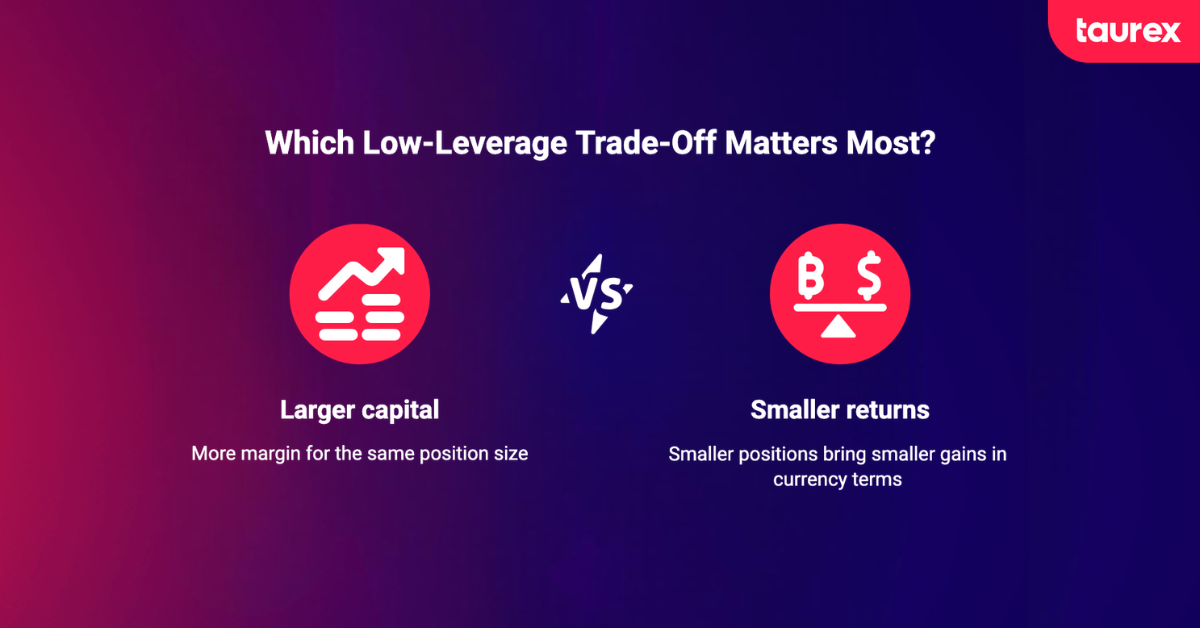
Larger Capital Requirements for the Same Position Size
That same standard lot of EUR/USD needs about $3,666.67 of margin at 1:30, compared with $220 at 1:500. With a smaller account, low leverage may mean you can only open small trades, or that you would need to deposit more money to hold the same position.
Lower Potential Returns on Smaller Positions
If limited capital keeps your position small, any gains in currency terms will be smaller too. Low leverage does not remove losses. It only limits how large a position your account can afford, and a small position can still lose money.
Risk of Overcommitting Available Capital
Free margin is your equity minus your used margin, the money left over to absorb losses or open new trades. If one low-leverage trade takes most of your account as margin, there is very little cushion left. Loss rates stay high even in capped markets, with BrokerRank reporting a 71.1% average retail loss rate across 49 EU and FCA-regulated brokers in 2026.
How Does Position Size Affect High and Low Leverage Trading Risks?
Position size decides how much you gain or lose on each price move, and leverage decides how large a position your account can open. The illustration below, for illustration only, shows a $1,000 account opening a $50,000 position that then moves 1% against the trader.
| 1:50 leverage | 1:500 leverage | |
| Margin required | $1,000 | $100 |
| Free margin after opening | $0 | $900 |
| Loss from a 1% adverse move | $500 | $500 |
| Account equity after the move | $500 | $500 |
The loss is the same in both columns. The only change is that 1:500 leaves $900 of free margin, which can tempt a trader into a much larger position, like the $200,000 trade from the earlier example. That is why many personal trading rules start with position size and a stop-loss level, then choose the leverage that fits.
How Do High and Low Leverage Affect Profits and Losses?
Gains and losses both grow in line with position size. High leverage can magnify results compared with the margin used and the size of your account, and that works in both directions. ASIC puts it plainly in its January 2026 report, noting that leverage and associated financing fees can magnify investor losses.
The data offers a useful reality check on the upside. Across 14 FCA-authorised UK CFD brokers, the mean retail loss rate was 69.9% as at April 2026. Results vary between providers, with BrokerRank’s figures ranging from 51% to 82%, so the outcome for any one trader depends on many factors beyond leverage alone.
When Does High Leverage Become Especially Risky?
Some market conditions can turn a thin margin buffer into a margin call very quickly.
- Around major news. Central bank decisions and NFP, CPI or GDP releases can move prices sharply within seconds.
- With several trades open. Used margin is already high, so one bad move can drag your margin level down.
- When free margin is thin. Spreads can widen in quiet market hours or around news, tipping a small buffer into a margin call.
- On volatile instruments. EU rules cap retail crypto leverage at 1:2 for this reason, compared with 1:30 on major Forex pairs.
- When maximum leverage is the default. Using the highest setting without sizing the trade first can lead to positions bigger than planned.
Spotting these moments early gives you a chance to reduce size before the market decides for you.
How Can Traders Manage Leverage Risks?
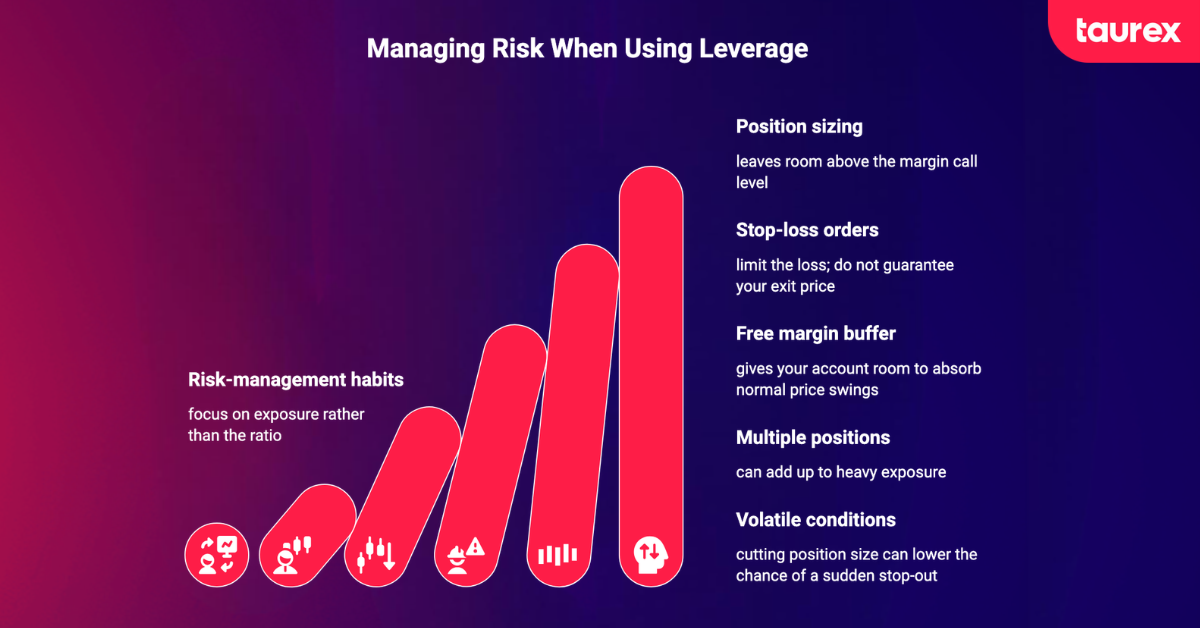
The habits below apply at any leverage, since they all focus on exposure rather than the ratio itself.
Choose Position Sizes Based on Your Risk Limits
Some traders size each trade so that a normal move against them still leaves plenty of room above the margin call level. Deciding how much you are prepared to lose first, then working out the position size, keeps leverage in a supporting role.
Use Stop-Loss Orders Carefully
A stop-loss is an order that closes your trade at a set price to limit the loss. Among the types of Forex orders, it is one of the most widely used. Spreads can widen near news, so a stop does not guarantee your exit price or remove all risk.
Monitor Margin Levels and Free Margin
Check your margin level during busy hours and before big data releases. Keeping a buffer of free margin gives your account room to absorb normal price swings without reaching a margin call.
Avoid Overleveraging Multiple Positions
Used margin is the total across all open trades. Several small positions can add up to heavy exposure, especially when they are in related pairs such as GBP/USD and EUR/USD that often move together.
Adjust Exposure During Volatile Market Conditions
Read your broker’s rules on margin changes around news events. Some traders cut their position size when markets feel unsettled, which can lower the chance of a sudden stop-out.
How Does Taurex Support Different Leverage Requirements?
At Taurex, we offer leverage of up to 1:2000 on Forex markets across our Standard Zero, Pro Zero and Raw accounts. We use a dynamic margin model, so the leverage on a new trade depends on your equity and position size, and hedged positions need 50% of the usual margin.
Our margin call level is 100% and our stop-out level is 20% on all three accounts. Around high-impact events, such as rate decisions and NFP, maximum leverage on new trades drops to 1:200 for Forex, metals, BTC and ETH, and 1:50 for indices and energies.
Higher leverage may suit experienced traders who use firm risk controls, but it may not suit everyone. Taurex Global Limited is regulated by the FSA of Seychelles (licence SD092), and you can read about our global regulations and how we handle the safety of funds.
FAQ
Is high leverage riskier than low leverage?
Often yes in practice, since high leverage makes larger positions affordable and leaves thinner buffers. For the same position size, though, the loss in currency terms is identical at any leverage.
Can you lose more money with high leverage?
Yes, if it leads you to open larger positions. Losses can exceed the margin a trade uses. Negative balance protection is mandatory for EU retail clients, but elsewhere it depends on the broker.
Does low leverage guarantee safer trading?
No. Low leverage limits how big a position you can open, but 2026 data from regulated, capped markets still shows retail loss rates of around 68% to 71%.
What leverage is considered high in Forex trading?
It depends on where you trade. Anything above 1:30 exceeds EU retail limits on major pairs, and US rules work out at about 1:50. In the high leverage vs low leverage debate, context matters.
How does leverage affect margin requirements?
The margin percentage equals 1 divided by the leverage. For one standard lot of EUR/USD at 1.1000, that means about $3,666.67 at 1:30, $1,100 at 1:100 and $220 at 1:500.
Can you change your leverage after opening a trading account?
It depends on the broker. With dynamic margin at Taurex, leverage on new trades can shift with your equity and position size. Check your account terms or contact support about account-level changes.
What leverage should a beginner use in forex?
There is no single answer for every trader. 1:500 sits far above the 1:30 retail caps in the EU and Australia. Some beginners practise on a demo account first and keep positions small.