Imagine you got stopped out on a EUR/USD position you felt good about. Your analysis was solid, your entry looked clean, but the market moved against you. Before you have had time to think, your fingers are already over the buy button, ready to jump back in and win it back. Sound familiar?
That urge has a name: revenge trading. It is one of the most harmful patterns in Forex trading, and it can blow accounts at every experience level. Between 74-89% of retail CFD and Forex accounts lose money, with emotional and revenge trading among the leading reasons.
In this article, we’ll cover what Forex revenge trading is, why it happens, how it shows up, and seven simple steps to stop it.
What Is Revenge Trading in Forex?
Revenge trading in forex is the act of placing impulsive trades after a loss in an attempt to recover money quickly. These trades are usually driven by frustration, anger, or pressure rather than a trading plan. It often leads to overtrading, larger position sizes, ignored stop-losses, and deeper losses. Your technical analysis and entry signal may have been perfectly sound. What breaks down is emotional control.
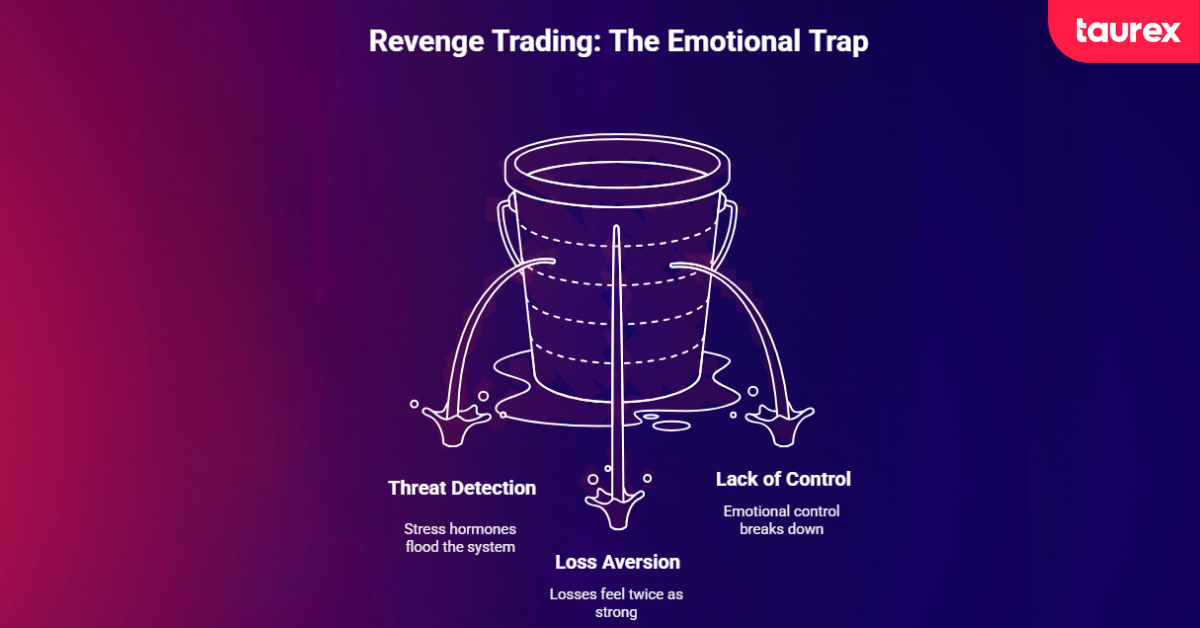
This is a biological response, not a character flaw. When you take a loss, the part of your brain that handles threat detection fires up. Stress hormones flood your system, while the part responsible for rational thought gets pushed aside.
Nobel Prize-winning research by Daniel Kahneman and Amos Tversky on loss aversion shows that people feel losses roughly twice as strongly as gains of the same size. That’s what makes the pull to revenge trade so powerful. Once you understand why it happens, you can build habits to interrupt it, and a solid foundation in Forex risk management goes a long way towards stopping the conditions that make it likely.
What Are the Revenge Trading Symptoms and Warning Signs?
Revenge trading usually happens when emotions take control after a loss. It can be subtle at first, but there are several common signs to watch for:
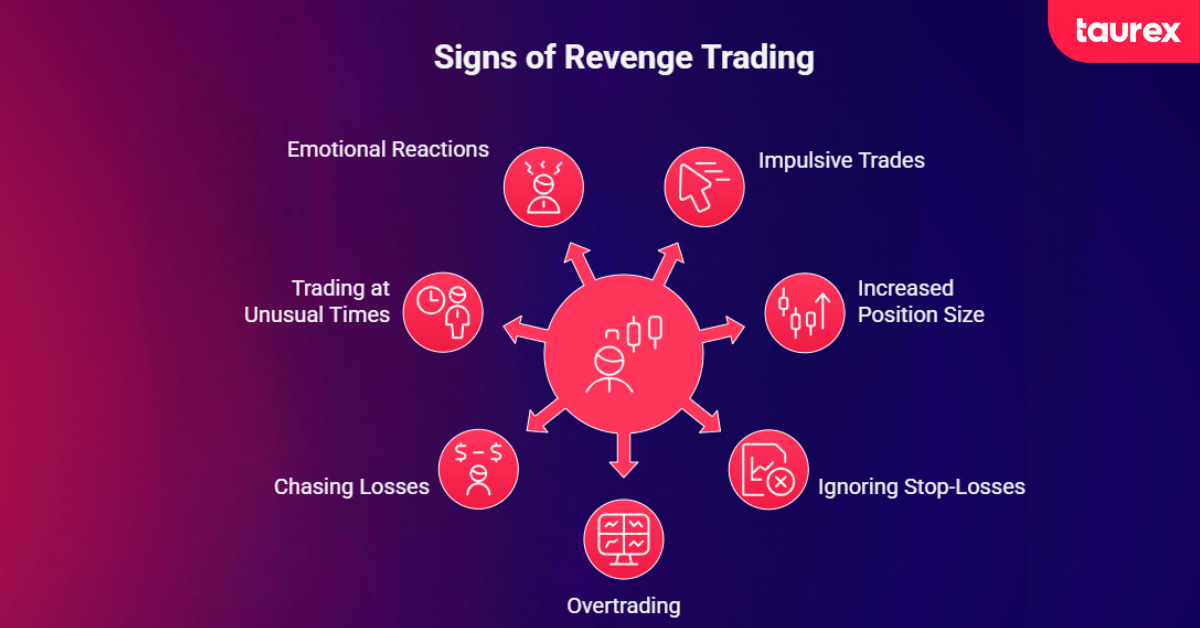
- Impulsive trades right after a loss: Entering positions quickly without following your plan.
- Increasing position size: Risking more than usual in an attempt to recover losses.
- Ignoring stop-losses or risk rules: Moving or skipping stop-loss levels.
- Overtrading: Opening more trades than planned, often driven by frustration or boredom.
- Chasing losses across trades or markets: Hoping one win will make up for previous losses.
- Trading at unusual times: Such as during periods of high forex volatility or when tired and stressed.
- Emotional reactions while trading: Feeling anger, anxiety, impatience, or desperation in the market.
Recognising these signs early can help you step back, review your trading plan, and take steps to avoid larger losses. Being aware of your own patterns is one of the first steps toward calmer and more consistent trading.
What Causes Revenge Trading in Forex?
Revenge trading rarely comes from a single cause. It tends to be several triggers building on each other.
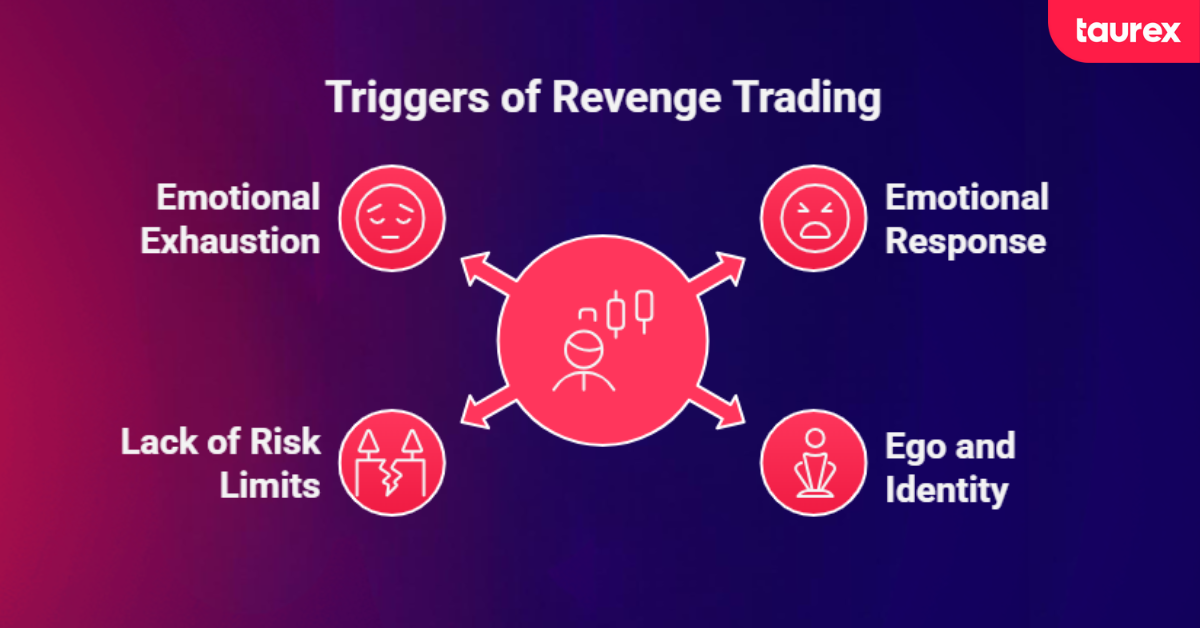
Emotional Response to Losing
A loss lands, and the reaction follows fast: anger, frustration, or embarrassment. Your brain reads the loss as a threat and pushes for quick action. The problem is that, in this state, “quick action” means jumping back into the market without a real basis. You stop seeing the chart and start seeing only the number you want to recover. Acting on raw emotion in a trading environment almost always makes things worse.
Ego and the Need to Be Right
Many traders take losses personally. A losing trade can feel like a statement about their skill or judgement, which fuels a strong urge to prove themselves, or even to “prove the market wrong.” In environments where results are visible to others, the added pressure can worsen the situation. When the motivation shifts from recovering money to recovering a sense of identity, the revenge impulse becomes much harder to resist.
No Predefined Risk Limits
Traders who go into a session without a daily loss cap or a per-trade risk limit have no circuit breaker. When a loss happens, and there is no set boundary, it can feel open-ended and out of control. But when you have a hard rule that says, “I stop after losing X% of my account today,” the loss stays within a range you already accepted before emotions were running high. That’s what makes Forex trading rules more than guidelines. They can act as psychological safety nets.
Emotional Exhaustion
Mental tiredness can weaken impulse control. After long hours at the screen, or when trading through stress or lack of sleep, the mental resources needed for self-control and disciplined decision-making start to run low. Research on sleep and self-control shows that sleep deprivation can increase impulsive behavior and weaken decision-making.
In trading, that loss of control can be especially dangerous after a loss, when stress, shame, and frustration may push traders toward revenge trading and a deeper cycle of poor decisions, as noted in Schwab’s article on recovering from major trading losses.
The Revenge Trading Cycle
Revenge trading often follows a repeated pattern. A planned loss creates frustration, the trader re-enters without a valid setup, the next loss increases emotional pressure, and the cycle continues. Recognising this pattern early can help traders interrupt it before a single loss turns into a larger drawdown.
| Stage | What happens | Risk |
| Loss | A planned or unexpected trade loss occurs | Emotional pressure increases |
| Impulse | The trader wants to win the money back quickly | Analysis becomes weaker |
| Revenge trade | A new trade is opened without a clear setup | Risk rules may be ignored |
| Bigger loss | The second trade also fails | Position size or trade frequency may increase |
| Loss spiral | More trades are opened to recover | Drawdown grows quickly |
Examples of Revenge Trading in Forex
Revenge trading can be obvious or subtle enough that you don’t spot it until after the damage is done. Here are six patterns to watch for.
Immediate Re-Entry
You get stopped out of a GBP/USD long, and within seconds, you place another buy order on the same pair with no new analysis. The only thing driving the entry is the emotional need to undo the previous loss, and that’s not a valid reason to put money at risk.
Doubling Down
Instead of re-entering at the same size, the trader doubles up. The thinking sounds reasonable: “If I put more on this trade, I only need a smaller move to break even.” This is the Martingale approach, and it can be dangerous. One more bad move at double the lot size can wipe out multiples of the original loss in a single candle, and it’s one of the fastest paths to a margin call.
The Domino Effect
This is what happens when revenge trading builds on itself. The first revenge trade produces a loss, which triggers another, and another. What started as a small drawdown can spiral within a single session. Each trade might look manageable on its own, but the combined damage is the real danger, and this pattern is what most often ends in a full account wipe.
Ignoring Strategy
At a certain point, some traders abandon their plan entirely. They stop waiting for entry signals, stop reading charts properly, and start placing trades on gut feeling or desperation. There’s no defined edge, no planned risk-to-reward, and no criteria for entry or exit, just the emotional need to do something.
Moving Stop-Losses
Rather than accepting a loss when a stop is about to trigger, the trader moves it further away, telling themselves they’re “giving the trade more room.” What they’re actually doing is turning a manageable, planned loss into an unplanned and potentially much larger one. Removing your risk parameters mid-trade is revenge trading by another name.
Correlated Revenge Trading
After losing on a USD/JPY position, a trader opens positions on EUR/USD, GBP/USD, and AUD/USD all in the same direction, intending to “spread the recovery.” The problem is that these pairs can be closely correlated, meaning a single move can close all positions at a loss at the same time. What feels like spreading risk can actually be concentrated exposure multiplied.
Revenge Trading vs Overtrading vs FOMO
| Pattern | Main trigger | Common behaviour | Key difference |
| Revenge trading | A recent loss | Re-entering quickly to recover money | Driven by frustration after losing |
| Overtrading | Impatience, boredom, or weak discipline | Taking too many trades | Not always linked to a recent loss |
| FOMO trading | Fear of missing a move | Chasing price after it has already moved | Driven by fear of being left out |
How to Avoid Revenge Trading in Forex: 7 Practical Steps
Learning how to stop revenge trading starts with understanding why it happens. Breaking the revenge trading cycle takes systems, not just willpower, because willpower is a limited resource that runs lowest exactly when you need it most, right after a loss. These seven steps create safeguards that work even when emotions are running high.
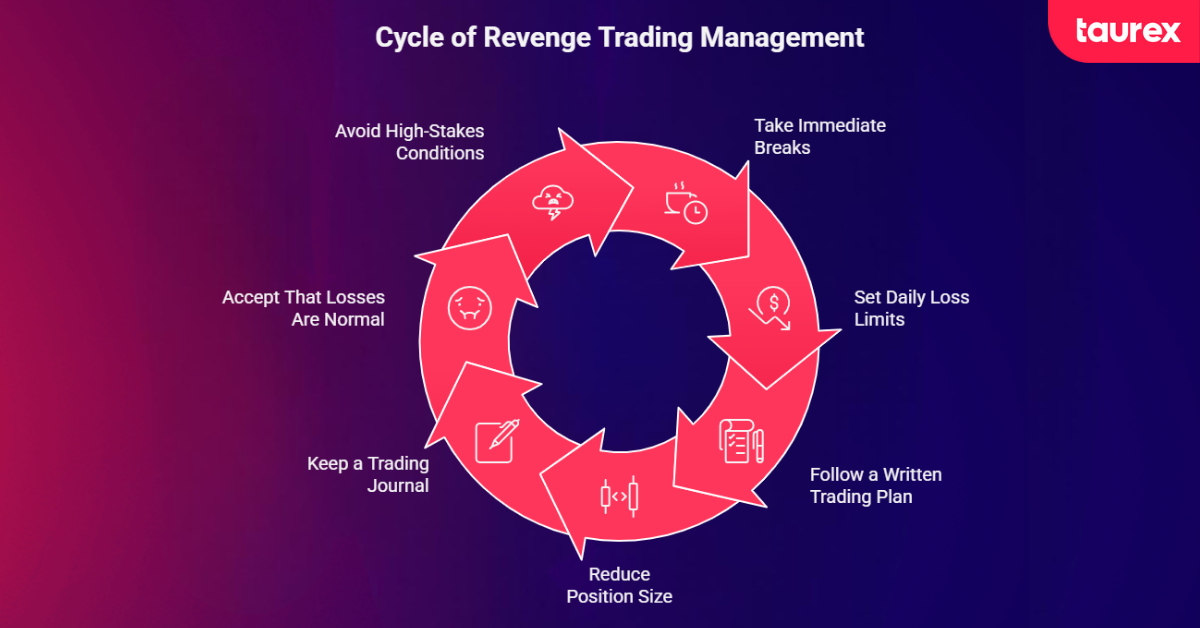
1. Take Immediate Breaks
If you feel the urge to trade again after a loss, it may help to step away from the screen. Even a short break can give you time to calm down and think more clearly. You might wait 30 minutes or return later. Simple breathing exercises may also help you relax.
2. Set Daily Loss Limits
Before you start trading, you could decide how much you are willing to lose for the day. If that limit is reached, stopping for the day may help reduce further losses and emotional decisions.
In our risk management guide, we recommend risking no more than 1 to 2% of account capital per trade, with a clear daily maximum set in advance.
3. Follow a Written Trading Plan
A trading plan can act as a guide for your decisions. It may include entry and exit rules, risk levels, and position size. If a trade does not match your plan, you might choose to skip it. Writing the plan down may make it easier to follow.
4. Reduce Position Size
After a loss, you may consider trading smaller sizes. Smaller trades can reduce pressure and may help you stay more balanced. You could return to your usual size once you feel more consistent again.
5. Keep a Trading Journal
A trading journal should record more than entry, exit, and profit or loss. Traders can also note why they entered the trade, how they felt at the time, the position size, time since the previous trade, and if the setup followed their plan.
Over time, these notes can reveal repeated revenge trading patterns, such as taking larger trades after losses, entering lower-quality setups during emotional sessions, or trading more often during certain forex market hours. This makes it easier to identify triggers and adjust behaviour before one loss turns into a larger mistake.
6. Accept That Losses Are Normal
Losses can be a part of trading. Even top Forex traders may have losing trades. Focusing on long-term consistency instead of individual results may help reduce emotional pressure.
7. Avoid High-Stakes Conditions After Losses
After a loss, it may help to avoid trading during major news events or very volatile periods. Strong price movements can increase stress, while wider forex spreads can also affect trade costs. Checking the economic calendar before trading can help traders identify high-impact events and decide when to step away.
| Step | What to do |
| Stop | Do not place another trade immediately after a loss. |
| Step away | Take a break from the chart for at least 15 to 30 minutes. |
| Review | Check if the lost trade followed your plan. |
| Reset | Confirm your daily loss limit and emotional state. |
| Re-enter only with a valid setup | Trade again only if the next setup matches your plan. |
Conclusion
Revenge trading is a psychological trap, not a strategy problem. It’s driven by loss aversion, ego, emotional tiredness, and the absence of pre-set rules. The seven strategies here can work together to interrupt the pattern before it builds.
What separates traders who grow from those who stagnate isn’t avoiding losses entirely. It’s responding to losses with discipline rather than impulse, and building that consistency over many trades.
If you’re looking to strengthen your approach, explore Taurex’s educational resources and risk management tools, and consider how Forex trading platforms platforms with built-in risk features can support a more disciplined process. You can also open a demo account to practise your strategy in real market conditions without risking real funds, and see how different tools and features can support a more structured trading process.
FAQ
What is revenge trading in forex?
Revenge trading in forex happens when a trader opens impulsive positions after a loss to try to recover money quickly. These trades are usually driven by frustration, anger, or pressure rather than a clear trading plan.
What causes revenge trading?
Revenge trading is often caused by emotional reactions to losses, overconfidence, fear of missing out, lack of risk limits, and the need to recover quickly. It can also happen when traders are tired, stressed, or trading during highly volatile market conditions.
What are the symptoms of revenge trading?
Common revenge trading symptoms include increasing position size after a loss, ignoring stop-losses, taking trades without a valid setup, trading more often than planned, and feeling angry or rushed while making decisions.
How do you avoid revenge trading in forex?
Traders can avoid revenge trading by following a written trading plan, setting daily loss limits, using stop-loss orders, taking breaks after losses, and keeping a trading journal. It also helps to avoid major news events or volatile sessions when emotions are already high.
How do you stop revenge trading after a loss?
After a loss, traders should pause before placing another trade. A simple post-loss routine can help: step away from the chart, review if the trade followed the plan, check the daily loss limit, and only return when a valid setup appears.
Is revenge trading the same as overtrading?
No. Revenge trading is usually triggered by a recent loss and the desire to win money back quickly. Overtrading means taking too many trades, but it may be caused by boredom, impatience, weak discipline, or poor planning, not only by a loss.
Can experienced traders fall into revenge trading?
Yes. Experienced traders can still fall into revenge trading, especially after a sudden loss, unexpected market move, or stressful trading session. Experience helps, but discipline, risk limits, and emotional control are still necessary.
Can a demo account help prevent revenge trading?
A demo account can help traders practise following a plan, using stop-losses, and managing emotions without risking real money. It is useful for building discipline, testing post-loss routines, and learning to wait for valid setups before trading live.