
A Forex leverage ratio sets how much market exposure each dollar of margin can support. With $1,000 in an account, 1:50 leverage supports up to $50,000 in positions, 1:100 supports $100,000 and 1:500 supports $500,000.
What leverage does not change is the profit or loss on a given position. A $100,000 position gains or loses the same amount per pip at any ratio. The ratio only changes how much margin the position ties up and how large a position the account can open.
This guide compares 1:50, 1:100 and 1:500 leverage side by side, shows how to calculate margin at each, explains what really changes between 1:100 leverage vs 1:500 and covers how Taurex sets leverage by account equity.
What Do 1:50, 1:100, and 1:500 Leverage Mean in Forex?
A Forex leverage ratio shows how much position value one unit of margin controls. At 1:50 leverage, $1 of margin supports $50 of position value; at 1:100 leverage, $100; and at 1:500, $500. Some platforms write the same ratios as 50:1, 100:1 and 500:1.
Margin is the part of the account balance a broker sets aside to keep a position open. It is not a fee and not a loan; it is returned when the position closes. The higher the leverage ratio, the smaller the margin needed for the same position.
One detail is easy to miss: profit and loss are calculated on the full position value, not on the margin. A 1% move on a $100,000 position is a $1,000 gain or loss, whether the trader posted $2,000 or $200 to open it.
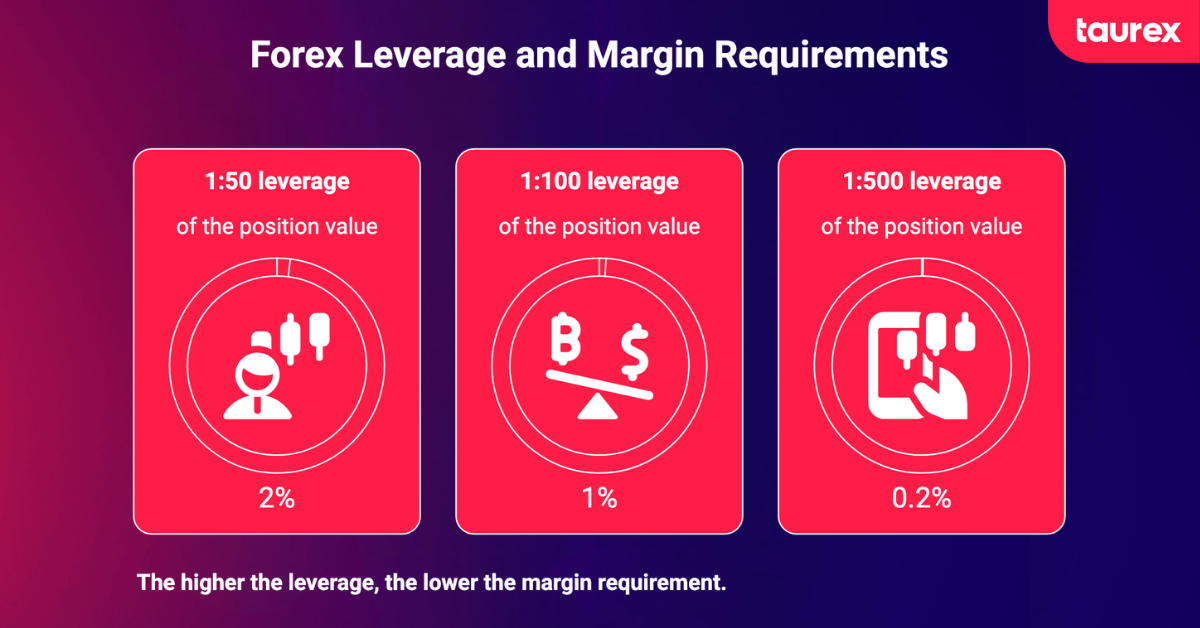
How Do 1:50, 1:100, and 1:500 Forex Leverage Compare?
The main difference between these ratios is the margin required to open a position of the same size. If the position size stays the same, a given market move produces the same profit or loss regardless of the leverage ratio.
The pip value also remains the same for that position. A pip is a standard unit of price movement in a currency pair, usually the fourth decimal place for pairs such as EUR/USD.
| Factor | 1:50 leverage | 1:100 leverage | 1:500 leverage |
| Margin required | 2% | 1% | 0.2% |
| Exposure from $1,000 in margin | $50,000 | $100,000 | $500,000 |
| Margin for a $10,000 position | $200 | $100 | $20 |
| Profit or loss on the same position | Same | Same | Same |
| Position size possible with the same margin | Smaller | Larger | Larger |
Consider a $100,000 position. A 1% adverse market move would result in a $1,000 loss at any of these leverage ratios, before Forex spreads and other trading costs. The margin required to open that position, however, would be $2,000 at 1:50, $1,000 at 1:100, and just $200 at 1:500. Lower margin requirements can make larger positions accessible with less capital, but they do not reduce the potential loss on a position of the same size.
The leverage available to retail traders also depends on the regulator and account classification. For example, US retail Forex rules generally limit leverage to 50:1 on major currency pairs, while EU and UK retail CFD rules generally cap it at 30:1 for major currency pairs. This means 1:100 and 1:500 may not be available to retail clients under those rules.
How Do You Calculate Margin for 1:50, 1:100, and 1:500 Leverage?
You can calculate the margin required for a Forex trade using a simple formula:
Margin required = Position value ÷ Leverage ratio
Divide the full position value by your leverage ratio to find the margin your broker requires. Some brokers express the same calculation as (market price × trade size) ÷ leverage, depending on how the position value is calculated. The examples below assume the position value is already expressed in USD. If you need a refresher on currency pair prices, read our guide on how to read Forex quotes.
How to calculate margin at 1:50 leverage
At 1:50 leverage, the margin requirement is 2% of the position value.
- A $10,000 position requires $10,000 ÷ 50 = $200 in margin.
- A $100,000 position requires $100,000 ÷ 50 = $2,000 in margin.
For a quick estimate, multiply the position value by 2%.
How to calculate margin at 1:100 leverage
At 1:100 leverage, the margin requirement drops to 1% of the position value.
- A $10,000 position requires $10,000 ÷ 100 = $100 in margin.
- A $100,000 position requires $100,000 ÷ 100 = $1,000 in margin.
You need half as much margin as you would at 1:50 for the same position size. However, the pip value and the resulting profit or loss remain the same if the position size does not change.
How to calculate margin at 1:500 leverage
At 1:500 leverage, the margin requirement is just 0.2% of the position value.
- A $10,000 position requires $10,000 ÷ 500 = $20 in margin.
- A $100,000 position requires $100,000 ÷ 500 = $200 in margin.
The lower margin requirement makes it possible to open a larger position with the same amount of capital. It does not reduce the potential loss on that position. For example, a 1% adverse move on a $100,000 position would still result in a $1,000 loss, before trading costs.
How to calculate position exposure from your margin
You can reverse the formula to calculate the position value supported by a given amount of margin:
Position exposure = Margin × Leverage ratio
With $1,000 in margin, the maximum theoretical exposure would be $50,000 at 1:50, $100,000 at 1:100, or $500,000 at 1:500. The actual amount you can open may be lower, depending on your available equity, broker requirements, and other open trades.
Two other figures help you monitor your account:
- Free margin: Your account equity minus the margin currently in use. It shows how much equity remains available to support new positions or absorb losses.
- Margin level: Your account equity divided by used margin, multiplied by 100. A falling margin level can trigger a margin call or automatic position closure when it reaches the broker’s specified threshold. Tracking Forex drawdown alongside your margin level can help you understand how losses are affecting your available equity.
The maximum exposure your leverage allows is a limit, not a recommended position size. Always account for the potential loss before deciding how much to trade.
What Are the Risks of Using 1:500 Leverage in Forex?
A 1:500 leverage ratio is not automatically riskier just because the number is higher. The risk comes from how much market exposure you take on relative to your account equity.
At 1:500, a $100,000 position requires just $200 in margin, but a 1% adverse move would still result in a $1,000 loss before trading costs. That is five times the margin initially required to open the trade.
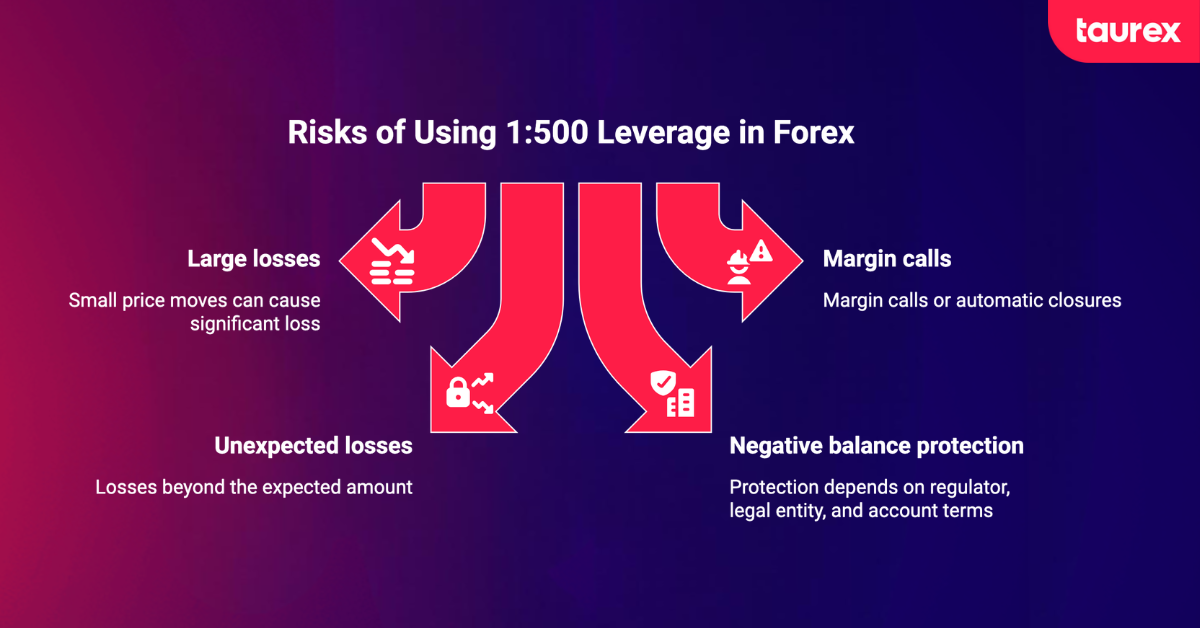
The main risks to consider are:
- Large losses from small price moves: When your position is large relative to your account balance, even a modest market move can cause a significant loss. Volatility around economic announcements, such as US nonfarm payrolls, can increase this risk.
- Margin calls and automatic closures: If your equity falls relative to the margin in use, your broker may issue a margin call or close positions once the account reaches its stop-out threshold. The exact rules vary by broker and account type.
- Losses beyond the expected amount: In fast-moving or gapping markets, a stop-loss order may be filled at a worse price than requested. A stop-out does not guarantee that your account balance will remain positive.
- Differences in negative balance protection: Some retail accounts have negative balance protection, which limits eligible clients’ losses to the funds in their trading accounts. The protection available depends on the regulator, legal entity, and account terms. Do not assume it applies to every account.
Retail trading loss disclosures also show why risk management matters. Brokers publish the percentage of retail CFD accounts that lose money, but the figures vary by provider and reporting period. They should not be treated as a single industry average or as a prediction of your own results.
Which Forex Leverage Is Best for Your Trading Strategy?
No single leverage ratio suits every trader. The right choice depends on your account size, trading strategy, position size, and risk tolerance. Lower leverage requires more margin for the same position, while higher leverage lets you open larger positions with less margin.
- 1:50 leverage: May suit beginners and traders who want to limit their available exposure. It requires 2% margin and matches the US retail Forex leverage limit for major currency pairs.
- 1:100 leverage: Offers a middle ground, requiring 1% margin. It may suit active traders who want more flexibility while managing position sizes carefully.
- 1:500 leverage: May suit experienced traders with a clear risk management plan. It requires just 0.2% margin, but larger positions can quickly increase losses. Retail availability depends on the jurisdiction and broker.
What Factors Should You Consider Before Choosing Forex Leverage?
Choose your leverage after setting your risk limits. These factors can help you decide how much exposure your account can support.
- Account equity and free margin: Keep enough free margin to absorb potential losses and support open trades.
- Position size: Your position size determines how much you gain or lose per pip, not the leverage ratio alone.
- Stop-loss and potential loss: Set your stop-loss before calculating position size. For example, risking 1% of a $10,000 account means a maximum planned loss of $100 per trade.
- Currency pair volatility: More volatile pairs, such as GBP/JPY, can experience larger price swings than USD/JPY, affecting potential losses. Reversal patterns such as the island reversal can signal sharp directional changes on these pairs, which matters more when high leverage is in use.
- Trading frequency and holding period: Multiple open trades and longer holding periods can increase your combined exposure to market movements. Consider how liquidity and volatility change during Forex market hours. Session-open strategies such as opening range breakout and price gap trading are particularly sensitive to leverage levels given the higher volatility at market open.
- Broker margin and close-out rules: Check your broker’s margin-call requirements and stop-out level before opening a trade.
- Regulatory restrictions: Leverage limits depend on the regulator, instrument, and client classification. Check which limits apply to your account before choosing a ratio.
Also, monitor your effective leverage, calculated as total open exposure divided by account equity. This shows how much market exposure you are taking relative to your account size, regardless of the maximum leverage advertised by your broker. Taurex supports MT4 and MT5, where you can monitor free margin and margin level.
What Forex Leverage Does Taurex Offer?
Taurex offers different leverage limits depending on the entity holding your account, your location, the instrument you trade, and your account equity. Maximum leverage can reach 1:2000 for eligible accounts, while the FCA-regulated UK entity has a lower retail Forex leverage limit of 1:30.
Taurex also uses a dynamic margin system, meaning leverage and margin requirements can adjust based on account equity, position size, and applicable trading conditions. For example, Taurex illustrates that an account with $2,500 in equity can access leverage of 1:2000, while a new trade opened after equity increases to $3,500 may receive leverage of 1:1000. In this example, the original trade retains its initial leverage.
Margin requirements also vary by instrument and position size, with larger positions generally requiring more margin. Additionally, during certain high-impact economic events, such as central bank interest rate decisions, Non-Farm Payroll releases, and CPI announcements, Taurex applies higher margin requirements to new trades. During these periods, maximum leverage is capped at 1:200 for Forex, metals, BTC, and ETH, and 1:50 for indices and energies. Higher margin requirements may also apply during daily rollover and around weekend market closures.
This means leverage levels such as 1:50, 1:100, 1:500, and up to 1:2000 may be available to eligible Forex clients, but the leverage applicable to a particular trade depends on account equity, the relevant entity, the instrument traded, and market conditions. Margin requirements, stop-out rules, and negative balance protection may also differ by entity.
Before you open a Forex trading account, review Taurex’s dynamic margin requirements, applicable leverage conditions, and safety of funds protections. You can also practise position sizing and margin management using a Forex demo account before trading with real money.
.
FAQ
What is the difference between 1:50 and 1:100 leverage?
At 1:50, the margin requirement is 2%, compared with 1% at 1:100. A $10,000 position requires $200 or $100 in margin, respectively. The profit or loss per pip stays the same if the position size is unchanged.
What is the difference between 1:100 and 1:500 leverage?
At 1:100, the margin requirement is 1%, while at 1:500, it is 0.2%. A $10,000 position requires $100 or $20 in margin. With $1,000 in margin, the theoretical exposure is $100,000 at 1:100 and $500,000 at 1:500.
How much margin is required for 1:500 leverage?
The margin requirement is 0.2% of the position value. A $10,000 position requires $20, while a $100,000 position requires $200. Calculate it by dividing the position value by 500.
Does 1:500 leverage mean you can earn 500 times more?
No. A 1:500 ratio lets you control a position worth up to 500 times the margin used. Your profit or loss depends on the position size and market movement, so higher exposure can increase losses as well as gains.
Is 1:50 leverage safer than 1:500 leverage?
Not automatically. A 1:50 ratio requires more margin for the same position, but risk still depends on position size, stop-loss placement, and account equity. The same position produces the same profit or loss at either ratio.
Can you lose more than your deposit when trading with leverage?
Yes, depending on your account protections and market conditions. Fast price movements can cause losses beyond the available balance, particularly where negative balance protection does not apply. Check the terms for your broker’s legal entity and account type.
What leverage is available to retail Forex traders?
Leverage limits depend on the regulator, instrument, and client classification. US retail Forex traders generally face a 50:1 limit on major currency pairs, while EU and UK retail CFD accounts generally have a 30:1 limit on major currency pairs. Other jurisdictions may permit higher leverage, so check the rules that apply to your account.