
When a Forex broker goes bankrupt, client money does not necessarily disappear with it. In a Forex broker bankruptcy, the outcome for each trader depends on three things: the broker’s legal entity, the regulator overseeing it, and how client funds were held.
Client money may be protected through segregation rules or compensation schemes, but these protections vary by jurisdiction and do not always guarantee a quick or full recovery. Open trades can also be affected while the broker’s affairs are being handled.
In this guide, we’ll explain what happens to your money and open positions when a broker becomes insolvent, how the recovery process works, and what you can check before opening an account.
What Happens When a Forex Broker Goes Bankrupt?
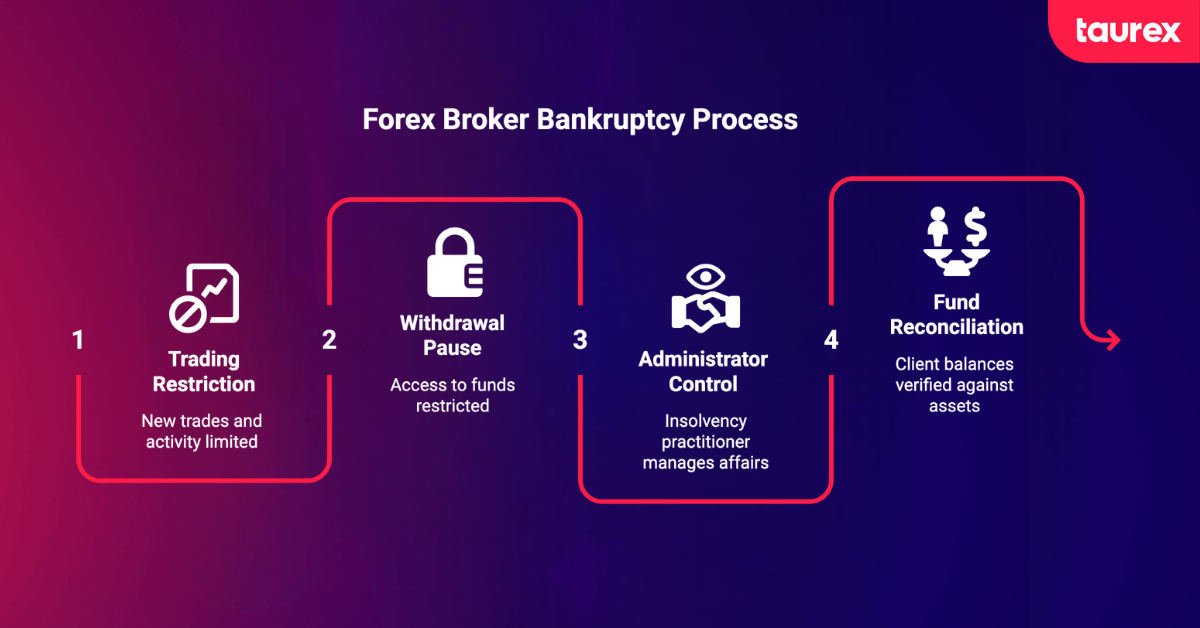
When a Forex broker becomes insolvent, the process depends on the jurisdiction, regulator, and type of insolvency proceeding. It may involve several steps:
- New trading may be restricted: The broker may stop accepting new trades or limit Forex trading activity while its financial position and client accounts are reviewed.
- Withdrawals may be paused: Access to funds can be restricted while client balances and assets are verified. The timing depends on the insolvency process and applicable rules.
- An administrator may take control: An insolvency practitioner or administrator may manage the firm’s affairs. In the UK, investment firms holding client assets can be subject to the Special Administration Regime, which includes rules for handling and returning client money.
- Client funds are reconciled: The administrator reviews the broker’s records and compares client balances with the funds held in client accounts to determine what each client is owed.
- Open positions may be closed or transferred: Depending on the circumstances, open trades may be closed at prevailing market prices or transferred to another broker.
What Happens to Your Money If a Forex Broker Goes Bankrupt?
How much a trader recovers depends on how client funds were held, whether there is a shortfall, and which regulatory framework applies.
- Client money may be held separately: Regulated brokers may be required to keep client funds separate from their own operating funds. This can help protect client money if the broker becomes insolvent, although the exact legal protections depend on the jurisdiction and applicable rules.
- Client funds are reconciled: An administrator reviews the broker’s records and compares client balances with the funds held in client accounts. Deposits, withdrawals, trades, and other account activity may form part of this reconciliation.
- A shortfall can affect the amount returned: If the money held for clients is less than the amount owed, clients may not recover the full balance. Any compensation available depends on the jurisdiction and whether the client and claim meet the scheme’s eligibility requirements.
- Recovery can take time: Withdrawals may remain restricted while claims are verified and funds are distributed. The timeline can range from months to longer, depending on the complexity of the insolvency.
- The legal entity matters: The protections available to you depend on the entity named in your client agreement and the rules that apply to it, rather than simply the broker’s brand name.
What Happens to Open Forex Trades When a Broker Fails?
An open position can continue to change in value while the broker’s insolvency is being handled. If the trade remains open, market movements can increase or reduce its unrealised profit or loss before it is eventually settled, and Forex drawdown can accumulate on losing positions during this period without the usual ability to manage or close them.
Pending orders can also be affected. Stop losses, take profits, and other instructions may be cancelled or become unavailable if trading is suspended. Forex spreads can also widen significantly during periods of uncertainty, affecting the prices at which any remaining positions are closed. You may also temporarily lose access to your platform or account while the broker’s records are being reviewed.
These issues can affect the final value of an open position, but they are separate from the process of recovering client funds.
How Long Does It Take to Get Your Money Back From a Failed Forex Broker?
There is no standard recovery timeline. Some clients may receive an interim distribution within months, while more complicated insolvency cases can take several years to resolve. The timeline depends on factors such as the broker’s records, the amount of client money available, the number of claims and the possibility of transferring client accounts to another broker.
What Should You Do If Your Forex Broker Goes Bankrupt?
If your broker becomes insolvent, focus on preserving your records and following the official process. These steps can help you protect your claim:
- Check the official announcement: Visit the regulator’s website or the insolvency practitioner’s page to confirm what has happened and find the instructions for clients. Avoid relying on forum posts or social media for important deadlines or claim information.
- Identify the legal entity: Check your client agreement, account statements, or the broker’s terms to find the company that holds your account. The protections that apply to you depend on this entity and its regulator.
- Save your account records: Download account statements, transaction histories, deposit and withdrawal records, and details of any open positions. Do this as soon as possible in case your platform access is later restricted.
- Submit any required claim: Follow the administrator’s instructions for submitting a claim or applying for compensation. Use the official claims process and provide the requested documents.
- Keep your own evidence: Store bank statements, payment confirmations, trade records, correspondence, and screenshots in one place. These records can help if there is a discrepancy between your records and the broker’s account data.
- Monitor official updates: Keep checking communications from the administrator, regulator, or compensation scheme. They may provide information about claim deadlines, distributions, transfers, or additional documents you need to provide.
Does Forex Broker Regulation Protect Your Money if the Broker Fails?
Regulation can provide important protections if a broker becomes insolvent, but it does not guarantee that every client will recover their full balance. The level of protection depends on the broker’s legal entity, the rules it must follow, and any compensation scheme available in that jurisdiction.
| Regulated broker | Unregulated broker | |
| Client fund segregation | Usually required | No enforceable requirement |
| Formal insolvency process | Regulator-supervised | May be unclear or cross-border |
| Compensation scheme | Possible, depending on jurisdiction | Typically none |
| Recovery prospects | Generally better, not guaranteed | Often limited |
A regulated broker can still fail, and problems such as missing records, a shortfall in client funds, or fraud can complicate recovery. Understanding types of Forex brokers and their regulatory models is a useful starting point before you commit capital anywhere.
How Can You Check Your Protection Before Opening a Forex Account?
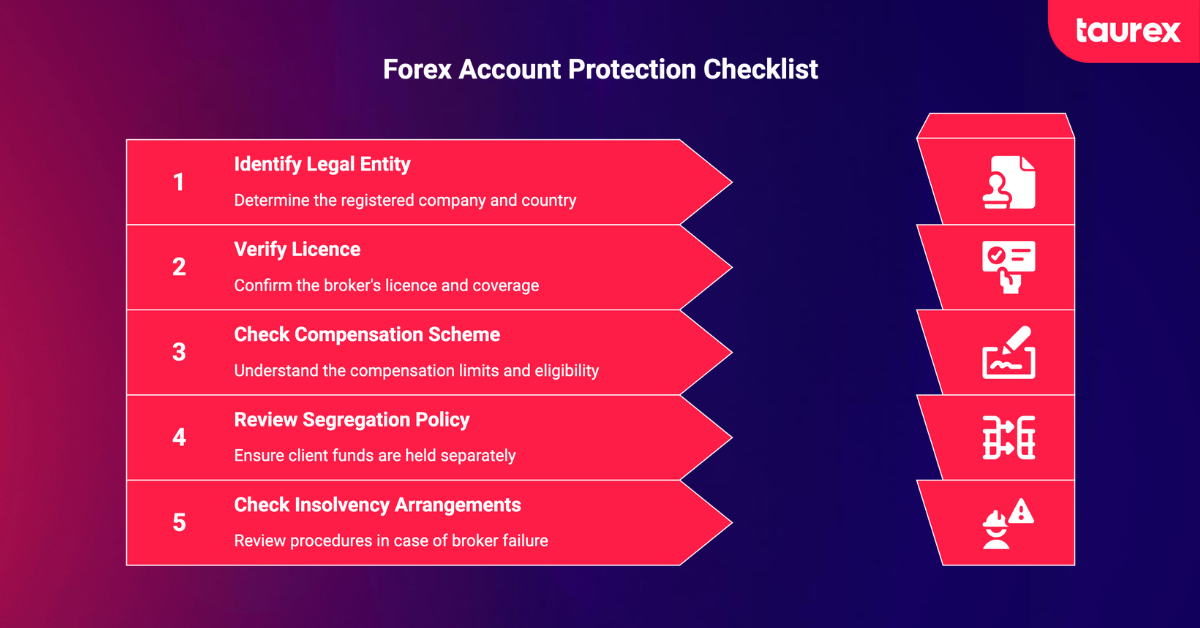
Before opening an account, check exactly which legal entity you will trade with and what protections apply to it. A few simple checks can help you understand what would happen if the broker failed:
- Identify the legal entity: Check the client agreement for the registered company name and country of incorporation. The broker’s brand alone does not tell you which regulatory framework applies.
- Verify the licence: Search the regulator’s official register using the broker’s licence number. Make sure the registered company name matches and that the licence covers the products and services you plan to use.
- Check the compensation scheme: Find out if the entity is covered by a statutory compensation scheme and what limits and eligibility requirements apply.
- Review the segregation policy: Check how client funds are held and if applicable rules require them to be kept separately from the firm’s operating money.
- Check the insolvency arrangements: Review what happens to client money if the broker fails and which administrator, compensation scheme, or other recovery process may apply.
Knowing how to choose a Forex broker can help you assess these factors before committing funds. It is also worth confirming that the broker supports the strategies you plan to use. This could include session-based approaches such as an opening range breakout or volatility-driven setups such as price gap trading strategies.
Execution quality and available order types can also vary between brokers. Also, understanding how to open a Forex trading account can help you know what information and documentation to expect during the process.
How Taurex Handles Client Funds and Regulatory Protection
Taurex operates through regulated legal entities in different jurisdictions, with regulatory oversight and client fund protections depending on the entity providing the trading services.
Taurex Limited is registered in England and Wales under company number 11077380 and is authorised and regulated by the UK’s Financial Conduct Authority (FCA) under firm reference number 816055. Its registered office is at 4th Floor, 4 Eastcheap, London, EC3M 1AE, United Kingdom.
Taurex Global Limited is registered in Seychelles under company number 8428731-1 and is regulated by the Financial Services Authority (FSA) of Seychelles under licence number SD092. Its registered office is at Suite 18, Third Floor, Vairam Building, Providence, Mahé, Seychelles. Its physical address is Suite 3, Office 4, Third Floor, KB Emporium, Providence, Mahé, Seychelles.
Taurex states that client funds are held separately from the company’s operational accounts. However, the specific regulatory protections and compensation arrangements depend on the legal entity holding the client’s account.
The Safety of Funds page provides information about Taurex’s fund-security measures, while the Global Regulations page outlines the group’s regulated entities and their respective roles.
Traders can review these details before opening a Taurex demo account and exploring the platform with virtual funds.
FAQ
Can I lose all my money if my Forex broker goes bankrupt?
It is possible, but bankruptcy does not automatically mean you lose your entire balance. The outcome depends on how client funds were held, whether there is a shortfall, and what protections apply to the legal entity holding your account.
Can I withdraw my money if a Forex broker becomes insolvent?
You may not be able to make a normal withdrawal while the insolvency process is underway. Any money you are owed is generally handled through the administrator or applicable compensation scheme.
What happens to my open trades if my Forex broker fails?
Open positions may be closed or transferred, depending on the insolvency arrangements. Market movements before a position is settled can also affect its final value.
How do I claim money from a failed Forex broker?
Follow the official process provided by the appointed administrator, regulator, or compensation scheme. You may need to submit account records and other documents to support your claim.
Does Forex broker insurance cover my trading losses?
No. Protection related to broker failure concerns the firm’s obligations to clients. It does not reimburse losses caused by your own trading decisions or normal market movements.
How can I check if a Forex broker has compensation protection?
Identify the legal entity holding your account, verify its licence with the relevant regulator, and check whether that entity falls under a statutory compensation scheme.
Can an unregulated Forex broker go bankrupt?
Yes. An unregulated broker can become insolvent, but clients may have fewer formal protections and no access to a statutory compensation scheme.
How long does a Forex broker bankruptcy claim take?
There is no fixed timeline. Some claims may be resolved within months, while complex insolvency cases can take several years.
What happens if a Forex broker has a client money shortfall?
If the broker cannot return all client funds, the amount available for distribution and any applicable compensation scheme determine how much eligible clients can recover.
Can I move my Forex account to another broker after an insolvency?
Possibly. If another firm takes over the client business, you may be offered a transfer. Otherwise, you would generally need to recover any amount owed through the insolvency process and open a new account separately.
What is the difference between broker bankruptcy and a trading loss?
Broker bankruptcy concerns the failure of the company holding your funds. A trading loss results from a change in the market value of your positions. Compensation for broker failure does not cover ordinary trading losses.