
Choosing between an ECN vs standard account usually comes down to one question: how does the broker charge for each trade? The spread shown on EUR/USD is only part of what a trader may pay to open and close a Forex position.
A standard account typically builds the broker’s fee into a wider Forex spread. An ECN-style account typically shows a tighter, near-raw spread and charges a separate commission. Neither is automatically cheaper. The answer depends on trade size, trade frequency and holding period.
This article compares spreads, commissions, execution, swaps and non-trading fees, with worked cost examples and Taurex’s current account terms, so traders can calculate the true cost of each option.
What Is an ECN Account in Forex?
An ECN account in Forex is a trading account that routes orders through an Electronic Communication Network. The network aggregates bid and ask prices from multiple liquidity providers, such as banks and other institutions. Traders see prices close to the underlying market quotes, and the broker usually earns a commission instead of widening the spread.
An ECN Forex account typically offers:
- Variable raw spreads that can fall close to 0.0 pips on major pairs in liquid conditions
- A separate commission, charged per lot either per side or per round turn
- No dealing desk, so orders are passed to liquidity providers rather than filled internally
- Market depth visibility on some platforms, showing available volume at each price
What Is a Standard Forex Account?
A standard Forex account usually charges no separate commission. The broker’s revenue is included in a marked-up spread, so the spread is the main trading cost. Depending on the broker, orders may be filled by a dealing desk or routed to liquidity providers.
Why Account Names Can Be Misleading
Brokers use labels such as “ECN”, “Raw”, “Zero” and “Razor” for similar tight-spread-plus-commission pricing. The label doesn’t always describe execution. Taurex’s account-type comparison lists ECN Forex execution for both its commission-free Standard Zero account and its commission-based Raw account, so the real difference is pricing. Comparing the actual spread, commission and fees is more useful than comparing names.
What Is the Difference Between an ECN and Standard Forex Account?
The main difference is how trading costs are presented. A standard account may include the broker’s markup in the spread, while an ECN-style account may offer a tighter spread with a separate commission.
| Cost | ECN-style account | Standard account |
| Spread | May be close to 0.0 pips on major pairs, depending on market conditions and broker | May be wider because the broker’s markup can be included in the spread |
| Commission | May apply separately, often charged per lot or per side | May be included in the spread, although some accounts can also charge a commission |
| Overnight swap | May apply when a position remains open past rollover | May apply when a position remains open past rollover |
| Other fees | Inactivity, withdrawal, conversion or other account fees may apply | The same types of fees may apply, depending on the broker |
| Total trading cost | Can be competitive for higher-volume trading, depending on spread and commission | Can be competitive for lower-volume trading, depending on spread and other fees |
How Do ECN and Standard Account Spreads Compare?
The main spread difference is how the broker presents its pricing. An ECN-style account may show a near-raw spread that changes with liquidity, while a standard account may include the broker’s markup in the quoted spread.
For major pairs such as EUR/USD, GBP/USD and USD/JPY, spreads can be tighter during periods of strong liquidity. They can also widen around major economic releases or when market liquidity falls. The London and New York overlap is one period when liquidity can be higher for many major pairs.
A quoted 0.0 pip minimum should therefore be treated as a minimum rather than the spread you should expect at all times. Check the typical spread during the hours and market conditions in which you trade.
How Do ECN and Standard Account Commissions Compare?
Commission is where the two pricing structures can look very different. An ECN-style account may charge a separate fee per lot, while a standard account may include its markup in the spread instead.
For example, suppose you trade 1 standard lot of EUR/USD and the ECN-style account shows a 0.1 pip spread with a $3 commission per side:
- Spread cost: 0.1 × $10 = $1
- Opening commission: $3
- Closing commission: $3
- Total: $7
A standard account showing a 1.2 pip spread with no separate commission would have a $12 spread cost on the same position.
The ECN-style account is cheaper in this example, but the break-even point changes with the commission and spread. With a $6 round-turn commission, a standard account at 1.2 pips would become cheaper once the ECN spread rises above about 0.6 pips.
This is why commission should always be converted into a per-trade amount before comparing accounts. Also check whether the advertised commission is quoted per side or for the complete round turn.
How Do Swap Fees Compare Between ECN and Standard Accounts?
Swap usually has less to do with the account label and more to do with the broker’s financing terms. Either account type may incur a charge or receive a credit when a position remains open through the daily rollover.
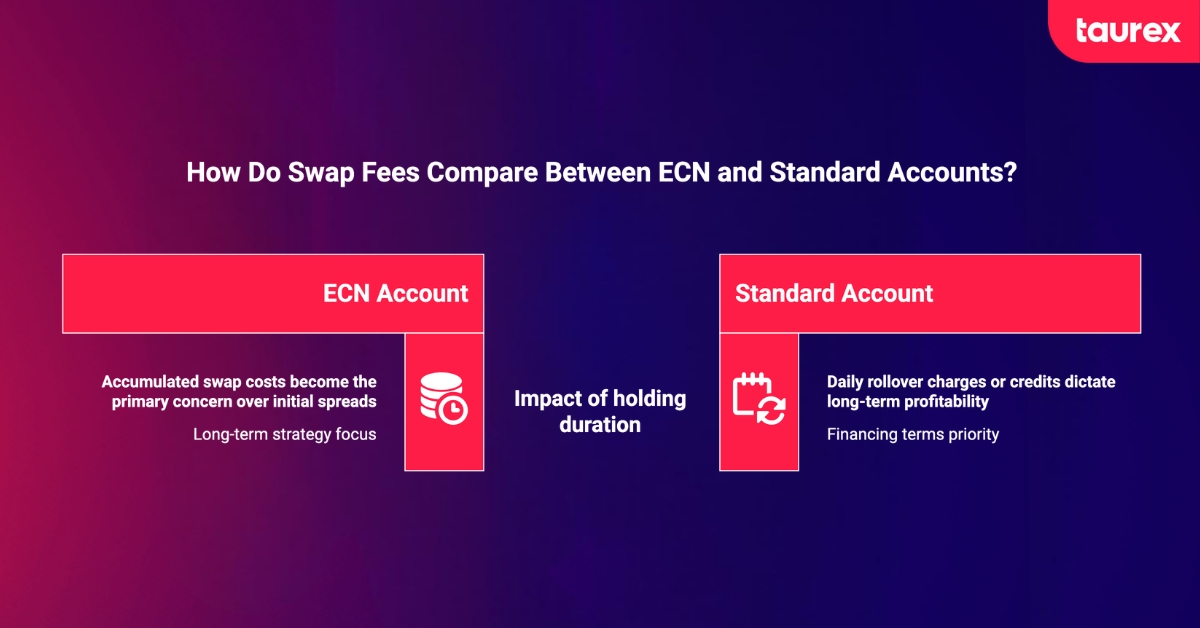
The amount can vary by currency pair, trade direction, position size and number of applicable swap days. Triple swap may also apply on a particular day to account for weekend settlement.
This becomes more important as the holding period increases. A trader keeping a position open for several weeks may need to pay more attention to the accumulated swap than to a small difference in the initial spread.
Which Account Type May Suit Different Trading Styles?
The useful distinction is how each pricing model behaves with your actual trading activity.
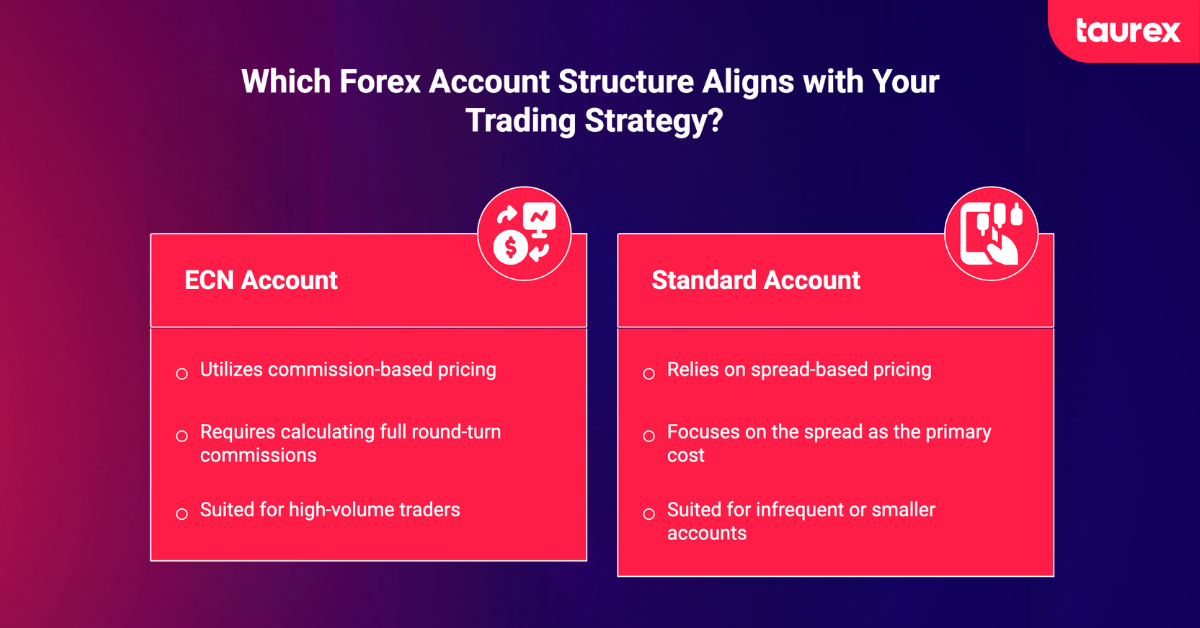
- Frequent traders: An ECN-style account may suit traders who place many trades because a tighter spread can offset the separate commission.
- Low-frequency traders: A standard account may be competitive when fewer trades are placed and the wider spread does not accumulate as often.
- Scalpers: Small spread differences matter more because the target on each trade may be relatively small. Commission needs to be included in the calculation.
- Swing traders: Overnight financing can become more important because positions may remain open for several days or weeks. Recognising reversal signals such as the island reversal pattern can help identify exits before accumulated swap and financing costs erode the position.
- News traders: Neither account type guarantees a stable spread during major announcements. Compare actual spreads during the releases you trade rather than relying only on the minimum advertised spread. Session-open strategies like an opening range breakout or price gap trading strategies are particularly sensitive to spread conditions at the open.
- Micro-lot traders: The dollar value of both spread and commission falls with position size, so the difference between account types may be relatively small in cash terms.
The best choice depends on your usual position size, trade frequency, holding period and the actual pricing available on the account. Comparing the cost of a typical trade is more useful than choosing an account based on whether it is labelled ECN or standard.
What Other Costs Should You Compare Between ECN and Standard Accounts?
Spread and commission are only part of the comparison. The account terms can also include costs or conditions that matter depending on how you fund, trade and hold positions.
- Swap and financing: Positions held past rollover may incur a charge or receive a credit. Compare the actual long and short swap rates if you regularly hold trades overnight.
- Slippage: Your order may be filled at a different price from the one you expected, particularly during fast-moving or less liquid markets. Slippage can increase or reduce your effective trading cost. On smaller accounts, these additional costs can accelerate Forex drawdown when combined with a run of losing trades.
- Currency conversion: A conversion cost may apply when your account, deposit or withdrawal uses a different currency. Check the broker’s exchange rate and any applicable conversion fee.
- Inactivity fees: Some brokers may charge a fee after an account remains inactive for a specified period. Check whether the account you are considering has an inactivity policy.
- Deposit and withdrawal fees: Funding and withdrawal costs can vary by payment method, currency and region. A broker may not charge a fee while your bank or payment provider does.
- Minimum deposit: This is not a per-trade cost, but it can affect how much capital you need to access a particular account type. Some commission-based accounts may have higher minimum deposits.
For a realistic comparison, calculate the cost of a typical trade using the spread, commission and expected swap. Then check the account terms for non-trading fees that could apply to the way you use the account.
How Do You Choose Between an ECN and Standard Forex Account?
The right account depends on how you trade, not simply on whether the account is labelled ECN or standard. Compare the costs using your own trading activity.
- Calculate your monthly trading volume. Note how many lots you typically trade. Commission-based pricing becomes more important as your trading volume increases.
- Check your typical holding period. If you regularly keep positions open overnight, include swap in the comparison rather than focusing only on the spread.
- Compare spreads on your main currency pairs. Use the pairs you actually trade and look at typical spreads during your trading hours. A low advertised spread on EUR/USD may not tell you much about the pairs you use most.
- Calculate the full commission. Check whether the quoted amount applies per side or to the complete round turn. For example, a $3.50 commission per side would amount to $7 for opening and closing one standard lot.
- Check the other account terms. Look at minimum deposits, inactivity fees, funding costs and currency conversion charges, particularly if you trade infrequently or use smaller accounts.
- Compare the cost of a typical trade. Add the spread and commission, then account for swap if you hold the position overnight. This gives you a more useful comparison than looking at either cost on its own.
You can test the available account types with a Forex demo account before committing funds. Keep in mind that trading conditions can differ when you move from a demo to a live account, particularly when real capital and execution are involved. You can also learn more about Forex live vs demo accounts before making the switch. When comparing brokers, consider regulation, execution, platforms and customer support alongside trading costs.
How Do Taurex Trading Costs Compare Across Account Types?
Taurex offers three main account types: Standard Zero, Pro Zero and Raw. Standard Zero and Pro Zero use spread-based pricing with no separate commission, while Raw offers spreads from 0.0 pips with a separate commission.
| Account | Minimum deposit | Spreads from | Commission |
| Standard Zero | $0 | 1.4 pips | $0 |
| Pro Zero | $100 | 1.0 pip | $0 |
| Raw | $500 | 0.0 pips | $3 per side |
Published minimums can vary by market conditions, instrument and jurisdiction. Check the current account terms for the conditions that apply to you.
The difference becomes clearer when you convert the pricing into a cost per trade. For example, on 1 standard lot of EUR/USD, a 1.4 pip spread would be about $14, while a 1.0 pip spread would be about $10, assuming a $10 pip value. On Raw, a $3 per side commission would be $6 for opening and closing 1 standard lot, before adding the spread.
These figures are examples rather than guaranteed trading costs. Actual spreads can change with market conditions, and the final cost of a Raw trade depends on the spread available when the order is executed.
Swap may also apply when positions remain open past the daily rollover. Traders who hold positions overnight can check the applicable swap rates for their instruments before comparing account types.
Rather than choosing an account based only on the lowest advertised spread, compare the spread, commission and any overnight costs against the way you trade. You can then open a demo account to explore the available trading conditions before using real funds.
FAQ
What is the difference between an ECN and standard Forex account?
A standard account may include the broker’s markup in the spread, while an ECN-style account may offer a tighter spread with a separate commission. Both account types can also have swap and other applicable fees.
Is an ECN account cheaper than a standard account?
It can be, depending on the spread, commission and how often you trade. A tighter ECN spread may offset the separate commission, while a competitively priced standard account may have a lower overall cost for some traders.
Are ECN spreads lower than standard account spreads?
They can be, particularly during liquid market conditions. However, spreads are variable and can widen on both account types during major economic announcements or periods of lower liquidity.
Do ECN accounts charge commissions?
Many ECN-style and raw spread accounts charge a separate commission based on trading volume. Check whether the quoted amount applies per side or to the complete round turn before calculating the cost.
Do standard Forex accounts charge commissions?
Some standard accounts have no separate trading commission because the broker’s markup is included in the spread. However, account terms vary, and other costs such as swap or withdrawal fees may still apply.
Is an ECN account better for scalping?
It can be suitable for scalpers because a tight spread may be useful when trading for relatively small price movements. Commission and slippage still need to be included when calculating the total cost of each trade.
Which Forex account is better for beginners?
A standard account may be easier to understand because the main trading cost can be reflected in the spread rather than a separate commission. However, beginners can compare both account types by calculating the cost of a typical trade.
How do I compare the total cost of an ECN and standard account?
Calculate the spread cost using the spread and pip value, then add any round-turn commission. Include swap for positions held overnight and other applicable account fees. Compare the result using the currency pairs, position sizes and trading frequency you actually expect to use.