
Most traders know the spread on their favourite currency pair. Fewer track what a trade actually costs after swaps, slippage, currency conversion and other fees are included. These costs can be easy to miss because they may not appear as a separate charge when you open a position, but they can add up over time.
The impact depends on how you trade. A scalper may notice slippage and spread changes more, while a swing trader can see overnight financing become a larger part of the total cost.
This article explains the main hidden Forex costs, how they affect different trading styles, and how to calculate the real cost of a trade before you open a position.
What Are the Most Common Hidden Forex Trading Costs?
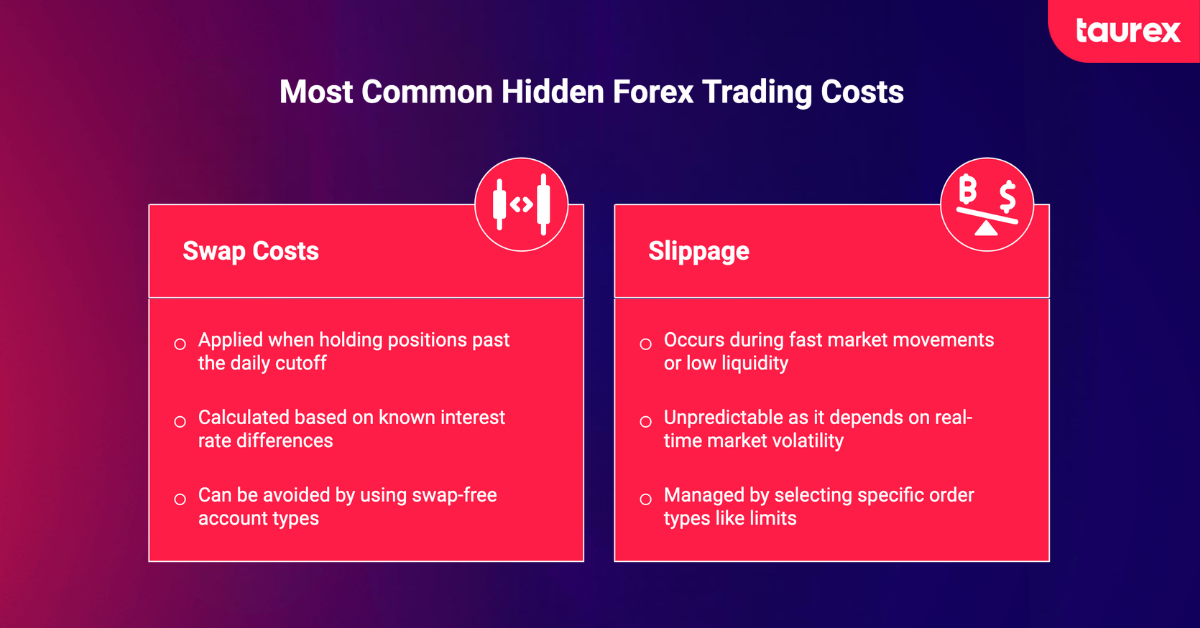
The Forex spread is only one part of the cost of opening and holding a position. Depending on how you trade, swaps, slippage, currency conversion, account fees and wider spreads during volatile markets can all increase your total cost.
| Hidden cost | When it applies | Most affected |
| Swap / overnight financing | Positions held past the daily rollover | Swing and position traders |
| Slippage | Fast markets, low liquidity | Scalpers, news traders |
| Spread widening | News releases, rollover, thin sessions | Scalpers, day traders |
| Currency conversion | Funding or trading in a non-base currency | Traders funding in other currencies |
| Deposit and withdrawal | Moving money in or out | Bank and third-party payment users |
| Inactivity | Account unused for a set period | Occasional traders |
| Platform and service fees | VPS, market data, maintenance | Algorithmic traders |
Swap and overnight financing costs
A swap is an overnight financing adjustment that can apply when a position remains open past the broker’s daily rollover time. The amount depends on factors such as the instrument, trade direction, applicable financing rates, and the broker’s current swap conditions, so it can be either a charge or a credit.
Wednesday often carries a triple swap to account for the weekend settlement period. This is a normal part of how swaps are calculated rather than an additional penalty. Swap-free accounts are available with some brokers, but they may have different spreads or administration fees, so check the replacement costs before switching.
Slippage
Slippage is the difference between the price you request and the price at which your order is filled. It is more common when markets move quickly or liquidity is low, and it can increase the cost of entering or exiting a position.
Slippage can be positive or negative. Keeping a record of requested and filled prices across several trades can help you see how much it affects your actual trading costs. It is also useful to understand the different types of Forex orders, since market orders, stop orders and limit orders can behave differently when prices move quickly.
Currency conversion fees
Currency conversion fees can apply when you deposit, withdraw or trade in a currency different from your account’s base currency. The cost may come from the broker, bank or payment provider, depending on how the transaction is processed.
For example, converting $5,000 at a 0.5% fee would cost $25. When comparing brokers, check the exchange rate and any conversion charges that apply to your account so you can include them in your overall trading costs.
Deposit and withdrawal fees
Funding costs depend on the broker and payment method. Some brokers offer free deposits or withdrawals for certain methods, while international bank transfers and third-party payment services may carry additional charges.
Even when the broker does not charge a fee, your bank or payment provider may deduct an amount before the funds reach your account. Check the full funding terms rather than assuming that a free deposit or withdrawal means the entire transaction is free.
Inactivity fees
Some brokers charge an inactivity fee when an account has not been used for a specified period. This can matter if you trade occasionally or keep an account open without placing trades.
Inactivity policies vary between brokers. Under Taurex Global Limited’s current Terms and Conditions, an account can be considered inactive after 90 calendar days without activity, and a monthly inactivity fee of $20 may apply after notification. Traders should review the terms applicable to the legal entity holding their account.
Trading platform or account fees
Some brokers charge separate fees for services such as market data, account maintenance or VPS hosting. This can matter to traders using a Forex trading robot who need a VPS to keep automated strategies running continuously.
There is no standard fee for these services, so check the broker’s full fee schedule before assuming that the advertised spread covers every account or platform cost.
Wider spreads during volatile markets
Spreads can widen sharply around major economic releases as liquidity changes and market prices move quickly. A 2026 study of US CPI and Nonfarm Payrolls releases found that the widest EUR/USD spread on the typical account reached about 5 pips, compared with a normal spread of around 2.1 pips. GBP/USD and USD/JPY spreads reached around 8 to 10 pips during the events studied.
These changes can have a noticeable effect on short-term trading costs. A wider spread increases the cost of entering or exiting a position and can also affect where a stop-loss is triggered. If you trade around major releases, compare spread behaviour for the currency pairs you trade most often, including EUR/USD, GBP/USD and USD/JPY.
How Much Do Hidden Forex Costs Affect Trading Profits?
The effect of hidden costs depends on your position size, trading frequency and how long you hold a trade. A few dollars per trade can become much more significant when repeated over dozens or hundreds of trades.
Example of costs on a single Forex trade
Here is an illustrative round-turn trade of one standard lot of EUR/USD, where one pip is worth about $10. The 1.4-pip spread and $3 per-side commission reflect Taurex’s published account pricing, while the raw spread, slippage and swap are assumptions used for the example. You can also learn more about Forex trading fees when comparing the different costs involved.
| Cost | Spread-Only Account | Raw Account |
| Spread | $14 (1.4 pips) | $2 (0.2 pip, illustrative) |
| Commission | $0 | $6 ($3 per side x 2) |
| Slippage | $3 (0.3 pip, illustrative) | $3 (0.3 pip, illustrative) |
| Swap | $8(4 × 2 nights, illustrative) | $8 ($4 × 2 nights, illustrative) |
| Total | $25 (2.5 pips) | $19 (1.9 pips) |
On these assumptions, the trade would need to move about 2.5 pips in your favour on the spread-only account and 1.9 pips on the raw account just to cover these costs. The actual cost will vary with the spread, execution price, swap rate and holding period.
How small fees add up over time
One trade may not seem expensive, but repeated costs can become significant. At 20 round-turn standard lots per month, a 1.4-pip spread would cost $280 per month, or $3,360 per year, before any other trading costs. A $6 round-turn commission on the same volume would cost $120 per month, or $1,440 per year, before adding the raw spread.
The size of your typical price target also matters. A 1.5-pip trading cost takes up a much larger share of a 5-pip target than a 200-pip target. This is why spread, commission and execution costs can have a greater effect on strategies that aim to capture small price movements.
Why high-frequency traders are more sensitive to costs
Scalpers and other high-frequency traders pay trading costs repeatedly because they open and close positions more often. Even a small difference in the cost per trade can become significant when multiplied across hundreds of trades.
Market conditions can add to this effect. For example, if EUR/USD spreads widen from 2.1 pips to 5 pips during a major economic release, the additional 2.9 pips represents about $29 more per standard lot. Traders who operate around news releases therefore need to account for both their normal trading costs and the possibility of wider spreads during volatile periods.
Which Forex Trading Costs Matter Most for Different Trading Styles?
The importance of each trading cost depends largely on how often you trade and how long you keep positions open. Here is how the main costs tend to affect four common trading styles.
- Scalping and high-frequency trading: Spreads, commissions and slippage matter most because costs are incurred repeatedly across many trades. Positions are often closed before the daily cutoff, so swap may have less impact. Execution quality and the cost of each entry and exit become especially important.
- Day trading: Spreads and commissions remain important, while temporary spread widening can add to costs around major economic releases. Many day traders focus on periods of higher liquidity, such as the London and New York session overlap. You can check Forex market hours when planning trades around the economic calendar.
- Swing trading: Swap becomes more important when positions remain open for several nights. Depending on the currency pair and position direction, swap can either be a charge or a credit. Pairs such as AUD/JPY and NZD/JPY can have different swap costs as interest rate differentials change.
- Longer-term positions: Swap can accumulate over weeks or months and may become a larger cost than the initial spread. Currency conversion and inactivity fees can also matter more when funds remain in an account for longer periods. The spread itself usually becomes a smaller part of the overall cost when a position targets a much larger price move.
How Can You Avoid or Reduce Hidden Forex Trading Costs?
You cannot eliminate every trading cost, but you can make them easier to control. A few simple checks can help you see what you are actually paying and avoid unnecessary fees.
- Compare account pricing with your trading volume. Look at the spread, commission and any other account fees together rather than choosing an account based on the headline spread. You can compare Taurex account types based on your typical position size and trading frequency.
- Compare the all-in trading cost. Calculate the combined cost of the spread and commission for a complete opening and closing trade. This gives you a more useful comparison when learning how to choose a Forex broker.
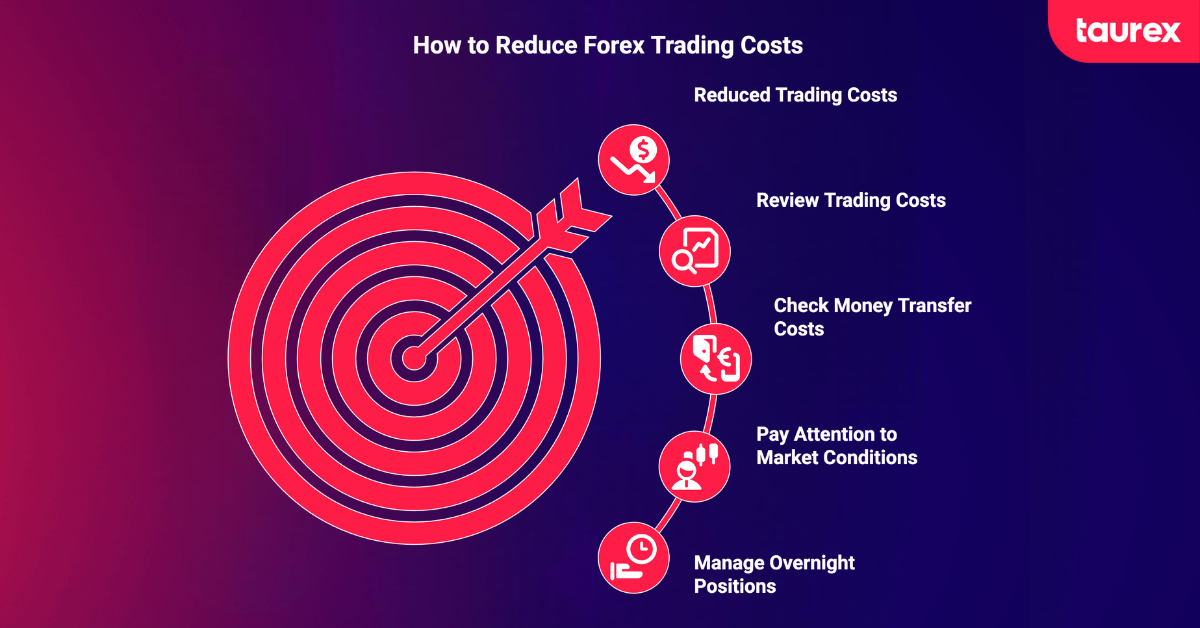
- Manage overnight positions. If your strategy allows it, closing a position before the daily cutoff can avoid another day’s swap. If you hold positions overnight, check the applicable swap rates and whether a triple swap applies.
- Pay attention to market conditions. Spreads can widen when liquidity falls, particularly around major economic releases. Trading during more liquid sessions can help reduce spread costs, while giving stops enough room can reduce the chance of being affected by temporary spread widening.
- Check the full cost of moving money. Before funding an account with a large amount, check the broker’s deposit, withdrawal and currency conversion terms. A small test transaction can also help you identify bank or payment-provider charges before you move larger amounts.
- Review your trading costs regularly. Keep a record of spreads, commissions, swaps and slippage alongside your trades. Reviewing these costs monthly or quarterly as part of your Forex risk management routine can show where most of your trading costs are coming from.
How to Calculate Your True Forex Trading Costs
A simple way to calculate the cost of a Forex trade is to combine the spread, commission, slippage and swap. Converting the result into pips makes it easier to compare different accounts and trading conditions.
True trading cost = spread cost + commission + slippage cost + swap
To calculate it for your own trades:
- Record the spread at entry. Note the difference between the bid and ask price when you open the trade. If you’re not familiar with bid and ask prices, you can learn how to read Forex quotes first.
- Add the round-turn commission. If the broker quotes commission per side, multiply it by two to account for both opening and closing the position.
- Add your actual slippage. Compare the price you expected with the price at which the order was filled, then record the difference in your trading journal.
- Add swap for positions held overnight. Multiply the applicable swap rate by the number of nights the position remains open.
- Convert the costs into a common unit. Expressing the total cost in pips makes it easier to compare different account types.
- Compare the cost with your expected price move. A 2-pip total cost has a very different effect on a trade targeting 5 pips than one targeting 100 pips.
The example earlier in this article shows how these costs can combine on a single trade. Also check whether a broker quotes commission per side or per round turn. For example, a $3.50 per-side commission becomes $7 for the complete opening and closing trade.
What Are the Forex Trading Costs at Taurex?
Taurex offers three account types with different spread and commission structures. The spreads below are minimum advertised rates, so actual spreads can vary with market conditions.
| Account | Min. Deposit | Spreads as low as | Commission |
| Standard Zero | $0 | 1.4 pips | $0 |
| Pro Zero | $100 | 1.0 pip | $0 |
| Raw | $500 | 0.0 pips | $3.00 per side |
For latest updates, check Taurex Accounts’ Page.
On one standard lot of EUR/USD, a 1.4-pip spread on Standard Zero would cost about $14, while a 1.0-pip spread on Pro Zero would cost about $10. On Raw, the $3.00 per-side commission comes to $6 for a complete opening and closing trade, plus the spread available at execution.
Swaps can apply to leveraged positions held past the daily close. Current swap values are shown in the trading platform, while swap-free accounts are available subject to eligibility and applicable conditions. Swap-free periods, excluded instruments, and possible admin fees can vary, so traders should review the current terms before holding positions overnight.
If you want to compare the costs in practice, you can open a Taurex demo account and monitor spreads and swap values before trading with real funds.
FAQ
What are hidden Forex trading costs?
They are costs beyond the headline spread, including swaps, slippage, currency conversion, withdrawal and inactivity fees, and wider spreads during volatile markets.
What is the highest hidden cost in Forex trading?
It depends on how you trade. Scalpers may be more affected by spreads, commissions and slippage, while swing and longer-term traders may pay more in swap. Wider spreads during major news releases can also increase the cost of individual trades.
Are swap fees a hidden Forex cost?
They can be if you do not account for them. Swaps can be either a charge or a credit depending on the currency pair and position, while Wednesday often includes three days of swap.
Can Forex spreads increase during volatile markets?
Yes. Spreads can widen when liquidity changes and prices move quickly, particularly around major economic releases. This can increase the cost of entering or exiting a position.
Is slippage a Forex trading fee?
Slippage is not usually listed as a separate fee, but it can affect your trading costs. It is the difference between the price you expect and the price at which your order is filled.
Do Forex brokers charge withdrawal fees?
Some do, depending on the broker and payment method. Your bank or payment provider may also charge a fee even when the broker does not, so check the full funding terms.
Do Forex brokers charge currency conversion fees?
Some do when you deposit, withdraw or move funds in a currency different from your account’s base currency. The broker, bank or payment provider may apply the charge.
How can I check all the costs of a Forex broker?
Start with the broker’s pricing and fee pages, then check swap rates, trading conditions and funding charges. You can also monitor your actual spreads, slippage and other costs on a demo or live account.
How do I calculate the total cost of a Forex trade?
Add the spread, round-turn commission, slippage and swap for the time you hold the position. You can then convert the total into pips to compare it with your expected price movement.
Are hidden Forex costs the same for every broker?
No. Brokers can set different spreads, commissions, swap rates and non-trading fees. Comparing the total cost of a typical trade gives you a clearer picture than looking at any single fee.