
Forex trading costs can be charged in different ways. The spread is reflected in the difference between the bid and ask price, while some account types also charge a separate commission, often alongside tighter spreads.
The difference can become significant when you trade frequently or use larger positions. This article explains how both pricing models work, how to convert them into a dollar cost per lot, and how to calculate the break-even point between them.
What Is The Difference Between A Forex Spread And A Commission?
A Forex spread is the difference between the bid and ask price, measured in pips. A commission is a separate fee, usually charged per lot, that brokers may apply when offering tighter raw spreads. Both are trading costs, but they appear differently on your account.
For example, if EUR/USD is quoted at 1.1000 bid and 1.1002 ask, the spread is 2 pips. A new position starts with an unrealised loss equal to the spread, so the price needs to move in your favour before the trade reaches break-even. If you are unfamiliar with bid and ask prices, you can learn how to read Forex quotes before comparing account pricing.
A spread-only account includes the broker’s fee in the quoted spread. A raw spread account shows a tighter market spread and charges a separate commission. This means you need to consider both costs when comparing the two account types.
Spread-Only vs Raw Spread Accounts
| Spread-only account | Commission (raw) account | |
| How the cost appears | Built into the bid-ask price | Tight spread plus a visible fee per lot |
| What stays fixed | Nothing, as the whole cost floats with the market | The commission per lot |
| What moves | The full spread | The raw spread portion |
How Much Does a Forex Spread Cost?
To turn a spread into money, you need the pip value. On a USD-quoted pair such as EUR/USD, one pip is worth about:
- $10 per standard lot (100,000 units)
- $1 per mini lot (10,000 units)
- $0.10 per micro lot (1,000 units)
The formula is:
Spread cost = spread in pips × pip value × number of lots
For example, a 0.8-pip spread on one standard lot would cost about $8. Actual spreads vary with market liquidity and trading conditions, so traders should compare the live spread available on their account rather than relying only on an advertised minimum.
The currency pair also affects the spread. Heavily traded pairs such as EUR/USD, GBP/USD and USD/JPY generally have tighter spreads, while less liquid crosses such as EUR/GBP and GBP/JPY can be wider.
Timing matters too. Spreads can widen around major economic releases, at daily rollover, late on Friday and around the Monday market open. The London and New York session overlap typically has stronger liquidity, which can support tighter spreads. You can also see how liquidity changes throughout the day depending on Forex market hours.
A 1.4-pip spread, for example, would cost about $14 on one standard lot. If market conditions temporarily push that spread to 3 pips, the cost rises to about $30. This is why traders should compare spreads under the conditions in which they actually trade, rather than relying only on the broker’s minimum advertised spread.
How Much Does Forex Commission Cost?
According to Fivetec Global Capital, raw account commissions at many Tier-1 regulated brokers in 2026 range from around $3.00 to $3.50 per standard lot per side. Some brokers charge more, while others calculate commissions based on the amount traded rather than a fixed fee per lot.
The term “per side” refers to one part of the trade. If a broker charges $3.50 per lot per side, you pay $3.50 when opening the position and another $3.50 when closing it. The total $7.00 is the round-turn commission. Converting this amount into pips makes it easier to compare a commission with a spread.
Converting Commission Into Pips
| Commission per side | Round-turn per lot | Pip equivalent at $10 per pip |
| $3.00 | $6.00 | 0.6 |
| $3.50 | $7.00 | 0.7 |
| $5.00 | $10.00 | 1.0 |
| $7.00 | $14.00 | 1.4 |
For example, suppose you trade one standard lot of EUR/USD on an account charging $3.50 per side. The total commission for opening and closing the position is $7, which is equivalent to 0.7 pips. If the account also has a 0.2-pip spread, your combined trading cost is roughly 0.9 pips, or $9 for the complete trade.
Forex Spread Vs Commission: How Do You Calculate the Total Trading Cost?
To compare different account types fairly, convert the spread and commission into one all-in cost:
For one standard lot of EUR/USD:
Total cost = (spread in pips × $10) + (commission per side × 2)
For other currency pairs, account currencies, or position sizes, the applicable pip value should be used instead.
The calculation takes three steps:
- Convert the spread into dollars by multiplying the spread in pips by the pip value.
- Double the per-side commission to get the round-turn cost.
- Add the spread cost and round-turn commission, then adjust for your lot size.
The example below uses one standard lot of EUR/USD, a complete opening and closing trade, and a pip value of $10. The Standard Zero and Pro Zero spreads and the Raw account commission are based on Taurex’s published minimums. The 0.2 and 0.5-pip Raw spreads are assumed examples for illustration, not published averages.
| Account | Spread used | Spread cost | Commission round turn | Total per lot |
| Standard Zero | 1.4 pips | $14.00 | $0 | $14.00 |
| Pro Zero | 1.0 pip | $10.00 | $0 | $10.00 |
| Raw, calm market | 0.2 pip (assumed) | $2.00 | $6.00 | $8.00 |
| Raw, busier market | 0.5 pip (assumed) | $5.00 | $6.00 | $11.00 |
In this example, the Raw account has the lowest total cost when the spread is 0.2 pips. If the spread widens to 0.5 pips, the total cost rises to $11 per lot, making the Pro Zero account cheaper at $10.
How Trading Volume and Position Size Change the Result
Trading volume makes these differences more noticeable. At 20 standard lots per month, the $6 difference between the $14 Standard Zero cost and the $8 Raw example adds up to $120. Costs also scale with position size. A 0.10-lot trade would have a $1.40 spread cost on Standard Zero, while the Raw example would have $0.60 in commission plus the cost of its spread, assuming the broker applies its commission proportionally to smaller positions.
The key point is that the cheapest account can change with market conditions. A raw account may have a lower total cost when spreads remain tight, but a wider raw spread can make a commission-free account cheaper for the same trade. Comparing the spread and commission together gives you a more realistic view of what each account costs.
Forex Spread Vs No Commission: Which Account Is Cheaper?
There is no single answer because the total cost depends on how often you trade, what you trade and when you trade. These factors can change the result when comparing raw spread and commission-free accounts:
- Frequency: Frequent traders can benefit from tighter raw spreads, but the commission still needs to be included in the total cost. Traders who place fewer trades may prefer the simpler pricing of a spread-only account.
- Currency pair: Spreads vary between pairs. Major pairs such as EUR/USD often have tighter spreads, while pairs such as AUD/USD, NZD/USD and GBP/JPY can be wider depending on market conditions.
- Trading session: Spreads can change as liquidity conditions change. Periods of weaker liquidity can be associated with wider bid-ask spreads, so the combined spread and commission should be compared under the market conditions in which the trader usually operates.
- Execution: The quoted spread is not necessarily the price at which your order will fill. Slippage can increase the actual cost, particularly during volatile markets. Understanding different types of Forex orders can help you compare how orders behave in these conditions.
- Holding period: For positions held overnight, swap and financing costs can have a greater effect on the total cost than a small difference in the opening spread.
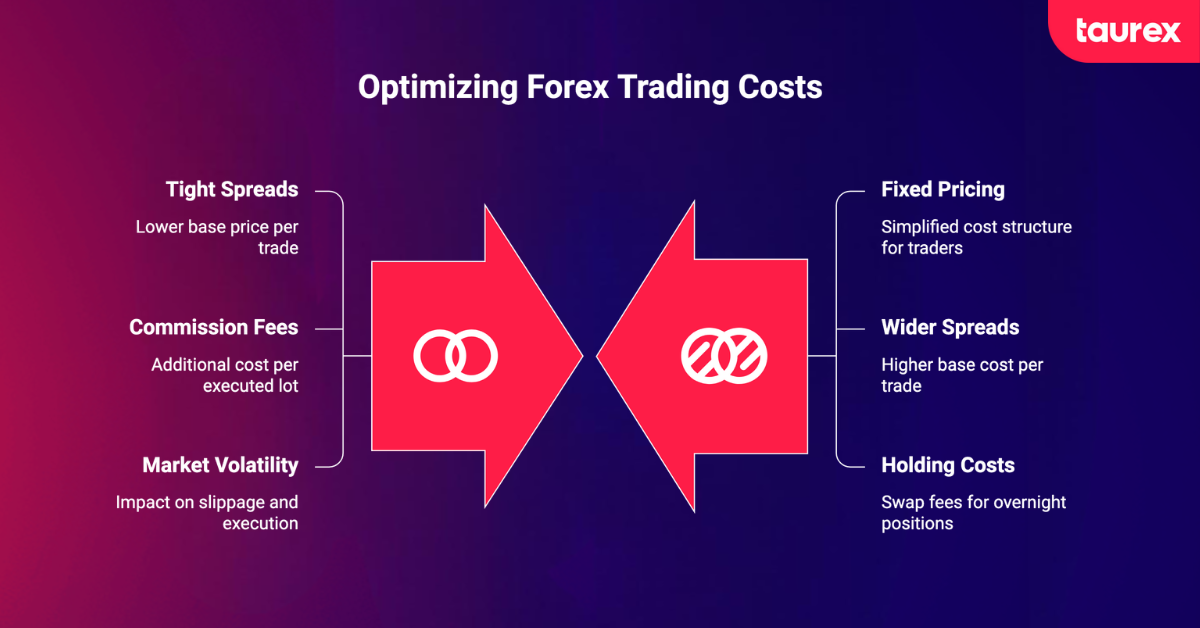
Some traders use different account types for different strategies or market conditions. The most useful comparison is therefore the actual cost of your typical trades, calculated using the spread, commission, position size and holding period.
What Is the Break-Even Spread Between a Commission and Spread-Only Account?
The break-even spread is the Raw account spread at which its total cost matches the cost of a spread-only account after commission is included. The formula is:
Break-even Raw spread = spread-only account spread − (round-turn commission ÷ pip value)
The table below applies this formula to Taurex’s published pricing, using a pip value of $10 per standard lot:
| Compare Raw against | Spread-only cost per lot | Raw commission round turn | Break-even Raw spread |
| Standard Zero at 1.4 pips | $14.00 | $6.00 | 0.8 pips |
| Pro Zero at 1.0 pip | $10.00 | $6.00 | 0.4 pips |
For example, if you compare Raw with Standard Zero, the spread-only account costs $14 per standard lot. The Raw account charges $6 in round-turn commission, leaving $8 of the $14 cost for the spread. At $10 per pip, that equals a break-even spread of 0.8 pips. A Raw spread of 0.5 pips would therefore cost $11 in total, compared with $14 on Standard Zero.
The break-even point changes when the commission changes. For example, with a $5 per-side commission, the round-turn cost would be $10, putting the break-even Raw spread against a 1.4-pip account at 0.4 pips.
The 1.4-pip and 1.0-pip figures are minimum advertised spreads, not guaranteed or average spreads. For a more realistic comparison, use the spreads available on the platform during the trading hours and currency pairs you actually use.
How Taurex Compares Spread and Commission Costs
Taurex offers three account types with different pricing structures. Standard Zero has no minimum deposit, spreads from 1.4 pips and no commission. Pro Zero requires a $100 minimum deposit, with spreads from 1.0 pip and no commission. Raw requires a $500 minimum deposit, with spreads from 0.0 pips and a $3.00 per-side commission. All three provide access to 1,500+ instruments, with Forex leverage of up to 1:2000 where permitted.
The main difference is how the trading cost is presented. Standard Zero and Pro Zero include the broker’s cost in the spread, while Raw combines a tighter spread with a separate commission. This gives traders three pricing structures to compare based on their typical position size, trading frequency and market conditions.
If you want to compare the account conditions in practice, open a Taurex demo account and test the spreads and trading conditions before using real funds.
FAQ
Is it better to pay commission or a spread in Forex?
Neither pricing model is cheaper in every situation. Compare the total cost for your typical position size, trading frequency, currency pair and trading session.
Is a 0.0-pip spread cheaper than a commission account?
Not necessarily. A 0.0-pip spread is usually associated with a separate commission, so you need to include both costs when comparing accounts. On the Taurex Raw account, the commission is $6 round-trip per standard lot.
How do you compare Forex spreads and commissions?
Convert the round-turn commission into its pip equivalent, add it to the raw spread, and compare the result with the spread-only account. For a standard lot of a USD-quoted major, the basic calculation is (spread × $10) + (commission × 2).
How much is a 1-pip spread worth?
On a USD-quoted pair such as EUR/USD, one pip is worth about $10 per standard lot, $1 per mini lot and $0.10 per micro lot. The exact value can vary for other currency pairs and account currencies.
What does commission per lot mean in Forex?
It means the broker charges a fee based on the amount traded. The rate may be quoted per side, per round turn or per million traded, so check which method the broker uses.
Is Forex commission charged on both the opening and closing trade?
Usually, a per-side commission is charged when you open the position and again when you close it. A $3.00 per-side commission therefore becomes $6.00 for a complete round turn.
Do larger Forex trades have higher spread costs?
Yes. The spread in pips may stay the same, but the dollar cost increases with position size. For example, a 2-pip spread on EUR/USD costs about $20 on one standard lot and $200 on ten lots.
What is a break-even spread?
It is the raw spread at which the total cost of a commission-based account matches a spread-only account. The exact level depends on the spread-only account’s spread and the commission charged.
Are spreads or commissions more important for scalpers?
Both contribute to the total cost. Scalpers should compare the combined spread and commission, along with execution and how spreads behave during volatile periods.
What other Forex trading costs should I look at?
Also consider overnight swaps, currency conversion fees, withdrawal or inactivity charges and slippage. These costs can affect the final amount you pay beyond the headline spread or commission.