
Key Points
- Three major central bank decisions land this week in the space of 72 hours: the Federal Reserve on Wednesday, the Bank of England on Thursday, and the Bank of Japan on Friday. All three are expected to hold rates steady, but the language from each press conference will set the direction for markets heading into August.
- USDJPY is trading near 163.57, close to a 40 year high for the dollar against the yen. The rate gap between the US (3.50% to 3.75%) and Japan (1.00%) continues to drive the pair higher, but the BoJ decision on Friday carries the risk of a surprise rate hike that could trigger sharp yen strength and a reversal of the current trend.
- Gold is attempting a recovery from the $4,000 area and is trading at $4,088, but remains well below its May highs above $4,500. The FOMC decision on Wednesday and the Core PCE inflation reading on Thursday will determine whether the Fed stays firm on rates or begins to soften its tone, and that will set the near term direction for gold.
The Central Bank Gauntlet
This is the biggest week for central banks in 2026 so far. Three rate decisions land in a 72 hour window, and each one has the potential to move currencies, equities, and commodities in a meaningful way.
The Federal Reserve announces its rate decision on Wednesday. The Bank of England follows on Thursday. The Bank of Japan closes the week on Friday. All three are expected to hold rates at their current levels, but the important part this week is not the decision itself. It is the tone.
Markets want to know whether rate cuts are getting closer in the US and the UK, and whether another rate hike is coming in Japan. The answers to those questions will come from the statements and press conferences, not from the rate decisions themselves.
On top of the central bank decisions, we get two critical US data releases on Thursday: GDP for the second quarter (forecast 2.3%) and the Core PCE inflation print (forecast 0.1% month on month). These are arguably the two most important numbers for the Fed’s next move, and the fact that they land on the same day as the Bank of England decision makes Thursday the most volatile day of the week.
Last week saw risk appetite dip after disappointing earnings from some of the biggest names in tech. The S&P 500 closed at 7,408, down 0.66% on the week, while the NASDAQ 100 fell 0.48% to 28,454. The Nikkei 225 in Japan bucked the trend, rising 1.04% to 64,805, supported by continued yen weakness.
USDJPY: The Carry Trade vs the BoJ
The dollar has been relentless against the Japanese yen this year. USDJPY is trading at 163.57, which is near a 40 year high for the dollar and a 40 year low for the yen. The pair has risen steadily since June, driven by one simple factor: the US pays significantly more interest than Japan.
The Fed’s target rate sits at 3.50% to 3.75%. The Bank of Japan’s rate is 1.00%. That gap of roughly 275 basis points makes it attractive for investors to borrow in yen (where rates are low) and invest in dollars (where rates are high). This strategy is known as the carry trade, and it has been one of the most popular trades in global markets this year.
The H4 chart shows a clean uptrend from the 160.50 area in mid June, with price making higher highs and higher lows through a series of bullish structural breaks. Demand zones are stacked between 162.00 and 162.50, and recent pullbacks have consistently found buyers at those levels.
The risk for USDJPY bulls sits on Friday. The Bank of Japan meets for its latest rate decision, and there is a real possibility that they raise rates again. The BoJ has already hiked to 1.00%, the highest rate since 1995, and Tokyo Core CPI (released Thursday evening) is forecast at 1.8% year on year, up from 1.6%. Rising inflation in Japan gives the BoJ reason to consider tightening further.
Japan also has a history of intervening directly in the currency market when the yen weakens too far. The Ministry of Finance spent roughly ¥11.7 trillion on intervention earlier this year, and although the yen gave back most of those gains, the threat of another round of intervention remains at these elevated levels.
If the BoJ holds rates and sounds cautious, the carry trade continues and USDJPY likely pushes higher toward the 164.00 resistance area. If they hike or signal that another increase is imminent, traders should be prepared for a sharp move lower as carry trade positions unwind.
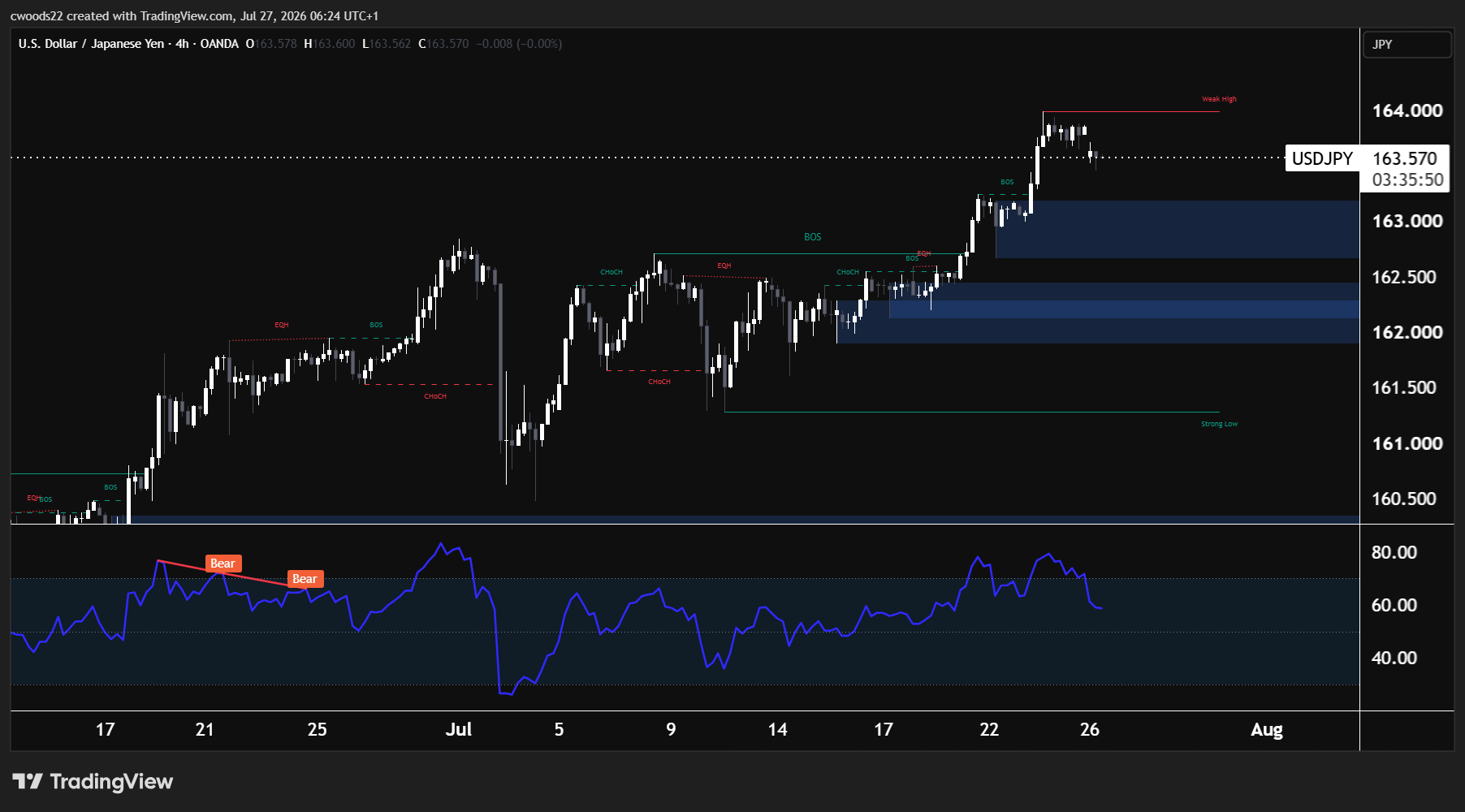
Chart: USDJPY, H4 timeframe (TradingView, SMC)
Gold: Waiting on the Fed
Gold has had a difficult stretch since its May highs above $4,500. The H4 chart shows a sustained move lower through a series of structural breaks, with the price currently trading at $4,088 after bouncing from the $4,000 demand zone in early July.
There are signs that the short term picture is improving. A bullish structural shift near $4,100 suggests that sellers have lost momentum on the lower timeframes. However, a significant supply zone sits between $4,150 and $4,250, and gold needs to break through that resistance convincingly before any genuine trend change can be confirmed.
The FOMC decision on Wednesday is the key event for gold. The Fed is widely expected to hold rates at 3.50% to 3.75%, but it is what Fed Chair Warsh says about the future path of policy that matters. Gold pays no income, so it competes directly with bonds and savings accounts that do pay interest. When interest rates are high, gold becomes less attractive because investors can earn a return elsewhere. When rates fall, gold becomes more appealing.
If the FOMC statement or press conference hints that rate cuts are getting closer, that would lower what is known as the “real yield” (the return you earn from bonds after subtracting inflation) and make gold more attractive. If the Fed sounds firm and suggests rates will stay at current levels for an extended period, gold could struggle to hold above $4,000.
The Core PCE inflation print on Thursday adds another layer. This is the Fed’s preferred measure of inflation, and the forecast is 0.1% month on month, down from 0.3% in the previous reading. If inflation comes in at or below expectations, it gives the Fed room to begin thinking about rate cuts later this year. If it surprises higher, it reinforces the “higher for longer” narrative and weighs on gold.
Gold tends to make its biggest move of the week around the FOMC decision. If the tone is softer on rates, look for gold to test the $4,150 to $4,250 supply zone. If the tone remains firm, the $4,000 demand area comes back under pressure.
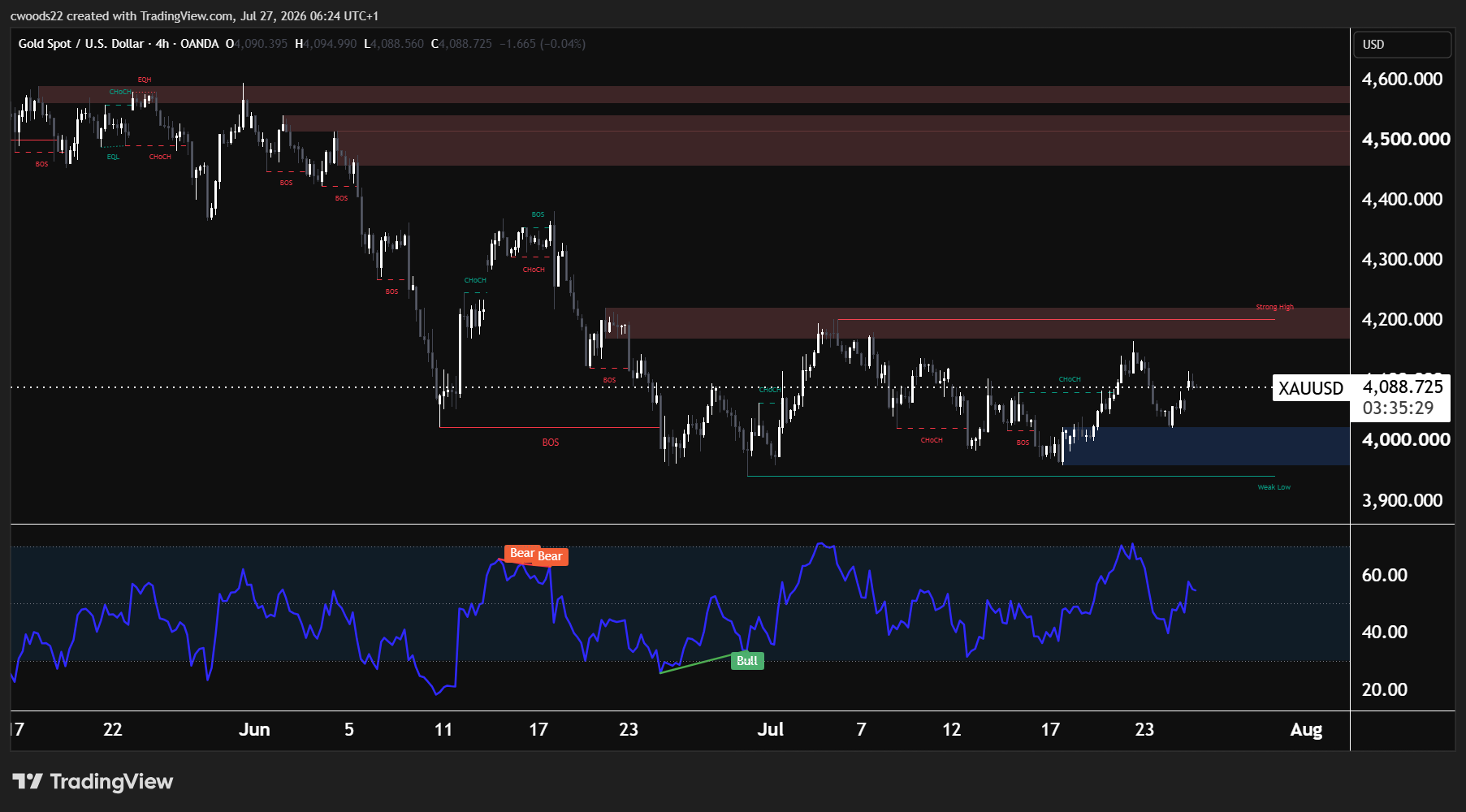
Chart: Gold (XAUUSD), H4 timeframe (TradingView, SMC)
Key Events This Week
All times shown in UTC. High impact events only.
| Day | Time (UTC) | Event | Forecast | Previous |
| Wed 29 Jul | 18:00 | FOMC Rate Decision (USD) | 3.75% (Hold) | 3.75% |
| Wed 29 Jul | 18:30 | FOMC Press Conference (USD) | — | — |
| Thu 30 Jul | 11:00 | BoE Rate Decision (GBP) | 3.75% (Hold) | 3.75% |
| Thu 30 Jul | 12:30 | US GDP Q2 (Advance) (USD) | 2.3% | 2.0% |
| Thu 30 Jul | 12:30 | Core PCE Price Index m/m (USD) | 0.1% | 0.3% |
| Thu 30 Jul | 23:30 | Tokyo Core CPI y/y (JPY) | 1.8% | 1.6% |
| Fri 31 Jul | 02:30 | BoJ Rate Decision (JPY) | Hold | 1.00% |
| Fri 31 Jul | 09:00 | Eurozone CPI Flash y/y (EUR) | 2.9% | 2.8% |
View our economic calendar here for the full schedule of events this week and their potential market impact.
| [INSERT ACUITY ECONOMIC CALENDAR SCREENSHOT HERE] |
Editor note: Insert Acuity economic calendar screenshot showing key events for 28 Jul to 1 Aug 2026
Risk Warning: Trading financial instruments, particularly those involving leverage, involves a substantial degree of risk and is not appropriate for all investors. The value of your investments can rise or fall sharply, and it is possible to lose the entirety of your invested capital. Do not trade with funds you cannot afford to lose. Nothing in this site should be read or construed as constituting advice on the part of Taurex or any of its affiliates, directors, officers or employees.