Many Forex traders spend hours watching charts, waiting for a clear setup. The opening range breakout trading strategy offers a more focused approach. Instead of following the market all day, you concentrate on the first 15 to 30 minutes of a major trading session. During this time, you mark the high and low, then wait for the price to break one of these levels before entering a trade.
The strategy was popularized by Tony Crabel and was first used in the stock markets. Over time, it has been widely adopted in Forex because it is simple, structured, and easy to test.
In this guide, you will learn how the strategy works, which pairs and timeframes to use, and how to enter and manage trades.
What Is the Opening Range in Forex and Why Is It Important?
The opening range breakout strategy definition is simple: the opening range is the highest and lowest price formed during the first 5, 15, or 30 minutes of a trading session. This creates a “box” that traders use as a reference. When the price breaks clearly above or below that range, it becomes the signal to trade.
This period matters because the start of a session brings a surge of activity. Overnight orders get filled, new data may be released, and large traders enter the market. As buyers and sellers compete, a direction often forms, which is what this strategy aims to capture.
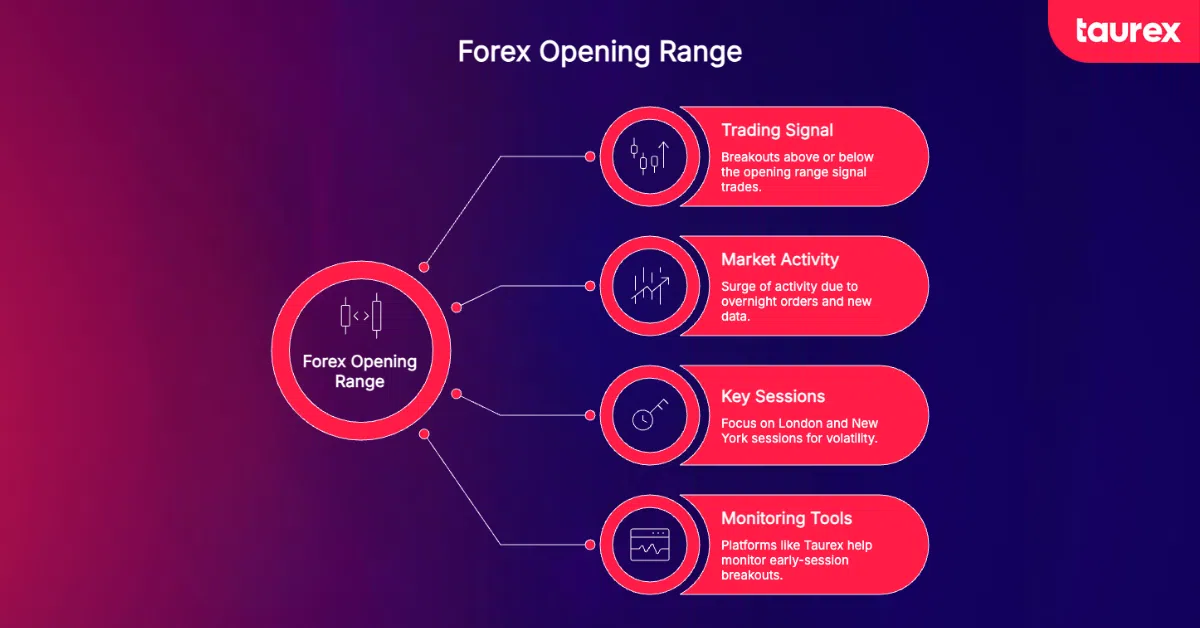
Since Forex runs 24 hours a day, 5 days a week, traders focus on key session opens such as London (8 AM GMT) and New York (1 PM GMT), when volatility is highest. The opening price often sits near the day’s high or low, making it one of the most important levels to watch.
Many traders monitor these levels through platforms such as Taurex to track early-session breakouts more effectively.
How Do You Apply the Opening Range Breakout Strategy in Forex?
Applying this strategy in Forex is simple, but it requires patience and discipline.
Start by choosing your session anchor. For major pairs like EUR/USD and GBP/USD, the London open is often the best fit. If you are trading USD/JPY or USD/CAD, the New York open may line up better with the liquidity and catalysts those pairs respond to. For JPY crosses like CAD/JPY or AUD/JPY, the Asian session can be worth exploring as well.
When the session begins, wait for your chosen time window, usually 5, 15, or 30 minutes. After that, mark the highest and lowest prices. This creates your opening range.
Next, wait for a clear breakout. Do not enter just because the price briefly moves outside the range. A candle should close fully above or below the range. If the move is weak, it is better to wait for the next candle to confirm. Some traders also check tools like VWAP, volume, or overall market direction before entering.
With Taurex, you can refine this process by tracking breakout confirmations across multiple timeframes and improving the precision of your entries.
Once the breakout is confirmed, you can enter at the candle close or wait for a small pullback to the range level. Place your stop loss on the opposite side of the range or near the middle. For profit targets, many traders aim for one to three times the size of the range, keeping a solid risk-to-reward ratio.
As the trade moves, you can lock in profits by trailing your stop. It is also smart to exit before major news events, as they can quickly change market direction.
What Are the Benefits of Using the ORB Strategy in Forex?
One of the main advantages of this strategy is its clarity. Your key levels are defined in advance, including the range high and low. This makes it easier to set stop loss and take profit levels without relying on guesswork.
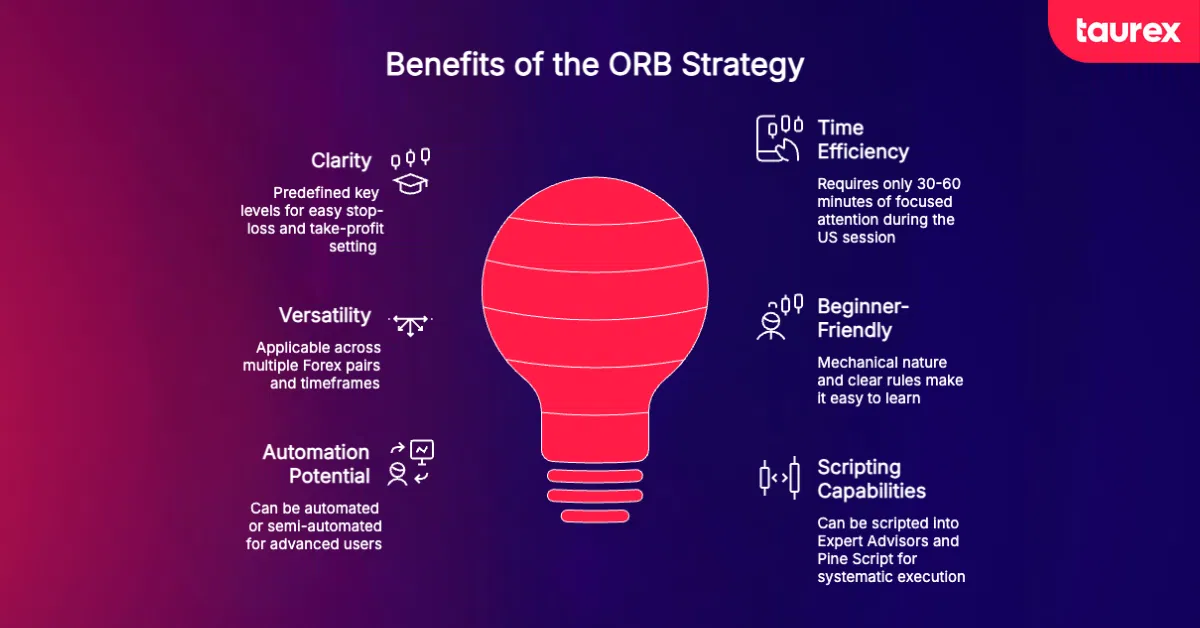
The strategy is also remarkably time-efficient. The ORB during the US session often requires just 30 to 60 minutes of focused attention, which is a far cry from monitoring charts throughout the entire day.
Beyond that, it is versatile. You can apply it across multiple Forex pairs and timeframes. It works on EUR/USD, GBP/USD, USD/CHF, USD/JPY, and others. The mechanical nature of the setup also makes it one of the more beginner-friendly strategies out there, since you are following a clear set of rules rather than relying on discretionary reads.
For advanced users, ORB can also be automated or semi-automated depending on the trading setup available on platforms like Taurex, especially when combined with rule-based execution tools.
And for those inclined towards automation, the ORB can be scripted into Expert Advisors on MetaTrader 4 and MetaTrader 5 or coded via TradingView Pine Script for systematic execution.
Which Timeframes Work Best for the ORB Trading Strategy in Forex?
The ORB (Opening Range Breakout) strategy relies heavily on timing, so choosing the right timeframe is critical for consistent results. Different trading styles, from scalping to swing trading, will work better on different timeframes.
5-Minute Range for Quick Scalps
The 5-minute opening range captures the high and low of just the first five minutes after the session opens. It gives you the earliest possible signal, which scalpers tend to appreciate. The trade-off is that these signals are the most prone to false breakouts, particularly in choppy or low-volume conditions. If you use this window, strict volume confirmation is not optional; it is the filter that separates usable signals from noise.
15-Minute Range for Day Trading
The 15-minute opening range breakout strategy is by far the most popular choice among retail Forex traders, and for good reason. Fifteen minutes gives the market enough time to absorb the initial flurry of Forex orders and begin showing genuine directional intent, without making you wait so long that you miss the bulk of the move. If you are new to the ORB trading strategy, this is the window we suggest starting with.
30-Minute Range for More Confirmed Breakouts
A 30-minute opening range produces fewer trade opportunities per session, but the setups that do emerge tend to carry more conviction. The downside is that the breakout has already travelled further by the time you get your signal, so your entry price is less favourable relative to the range boundary. This timeframe suits traders who prefer quality over frequency.
How Timeframe Affects Signals and Noise
The shorter the window, the more trades you will see, but the higher the false breakout rate. Longer windows clean up the noise at the cost of delayed entries. A popular advanced approach is to define the opening range on the 15-minute chart and then trigger entries on the 5-minute or 1-minute chart for more precise positioning.
This 5-minute window can work well at times, but it also gets really chopped in other conditions. The only way to know what works for your pairs and sessions is to backtest before committing.
What Are the Entry, Exit, and Risk Management Rules for ORB?
The trading rules for ORB entry are simple but strict, and they require patience and clear confirmation rather than guessing.
Entry Rules
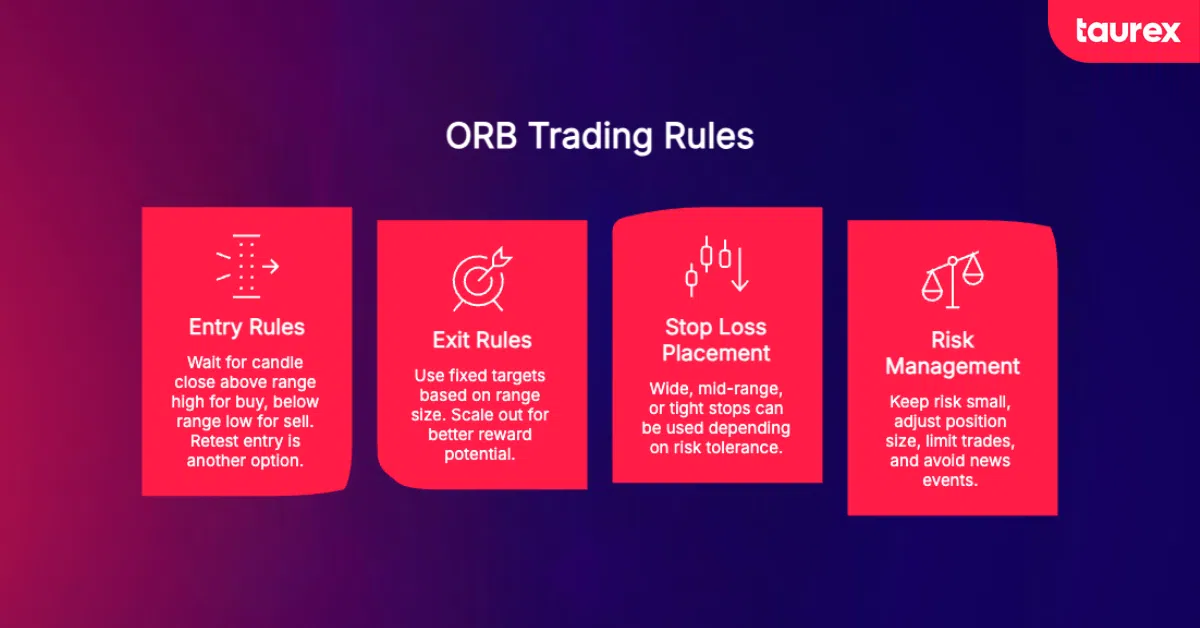
- For a buy trade, wait for a candle to close clearly above the range high. For a sell trade, wait for a close below the range low. Avoid entries based only on wicks breaking the level.
- A second option is the retest entry, where price breaks out, returns to the level, holds it, and then continues in the breakout direction.
Exit Rules
- Exits are usually planned using fixed targets based on the size of the opening range.
- A common approach is to take profit when the price moves a distance equal to the range.
- A second target can be set at two times the range or at nearby support and resistance levels.
- Many traders also scale out, closing part of the position early and letting the rest run if momentum continues.
Stop Loss Placement
- A wide stop is placed on the opposite side of the range, giving the trade more room.
- A mid-range stop is placed near the 50% level of the range and balances risk and reward.
- A tight stop sits just beyond the breakout candle and offers better reward potential, but is more likely to be hit by noise.
Risk Management
- Risk per trade is usually kept small, around 0.5% to 1% of account equity.
- Position size should adjust based on the range size to keep risk consistent.
- It is also important to limit trades per session and avoid high-impact news events, which can create unpredictable volatility.
Real Forex Examples of Using the ORB Strategy
To understand how the Opening Range Breakout works in real conditions, it helps to look at actual market scenarios. Below are two examples that show both a successful trade and a false breakout.
Example 1: EUR/USD, London Open, 15-Minute ORB
EUR/USD trades between 1.1000 and 1.1050 during the first 15 minutes of the London session, from 8:00 to 8:15 AM GMT. This creates a 50 pip opening range. You mark the high and low on your chart.
At 8:20 AM, a 5-minute candle closes at 1.1058, fully above the range high. Momentum looks strong. VWAP is pointing upward, RSI is at 62, and volume is higher than average, confirming strength.
You enter a buy trade at 1.1058. Your stop loss is placed at the midpoint of the range at 1.1025, giving you 33 pips of risk. Your target is set at 1.1108, which equals one full range projection. The trade reaches the target within two hours and is closed for a profit.
Example 2: GBP/USD, New York Session, False Breakout Scenario
GBP/USD forms an opening range between 1.2640 and 1.2680 during the first 15 minutes of the New York session, a 40 pip range.
Price then moves above 1.2680, but the candle does not close strongly outside the range. Volume is weak, and VWAP is flat, so there is no strong confirmation. You avoid entering the trade.
Soon after, the price fell back into the range, confirming it was a false breakout. Later, a clean move develops below 1.2640 with stronger volume and downward momentum. This time, the short trade meets all conditions and becomes a valid ORB setup.
What Are the Common Challenges in Using the ORB Strategy and How Can You Overcome Them?
False Breakouts
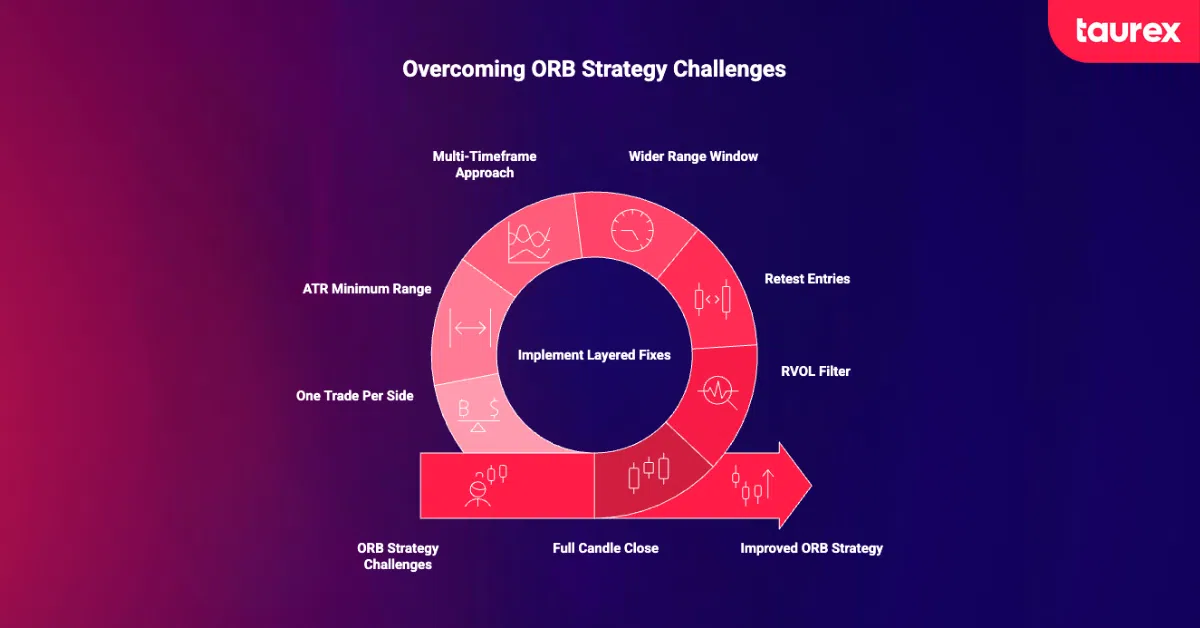
This is the single most common issue with any opening range breakout strategy. Price pokes through the range boundary and then snaps right back inside. Fakeouts happen most frequently with the 5-minute window, during low-volume opens, and in the minutes surrounding major news releases. The fix is layered: require a full candle close outside the range, demand that relative volume (RVOL) on the breakout candle exceeds 1.5 times the average, and consider retest entries instead of chasing the initial push.
Market Noise at the Open
Early-session volatility can whip price back and forth through both range boundaries without establishing any real direction. Using a wider range window (15 or 30 minutes) or a multi-timeframe approach, where you define the range on the 15-minute chart but trigger entries on the 5-minute chart, can help filter out these noisy conditions.
Overly Narrow Opening Ranges
When the opening range is unusually tight, breakouts frequently fail because the market has not shown enough directional conviction during the formation period. A practical solution is to apply an ATR-based minimum range filter. If the opening range is smaller than 0.3 times the 14-period Average True Range, it may be worth skipping that session entirely.
Chasing Breakouts
If you missed the initial entry and the price has already moved significantly beyond the range boundary, entering late usually means a poor risk-to-reward setup. The retest entry variation solves this: wait for the price to pull back to the broken level, hold it, and then continue in the breakout direction.
Overtrading
The temptation to take both long and short ORB signals in the same session, especially after getting stopped out once, can erode an account quickly. Stick to one trade per side per session, and if your first trade gets stopped, step away.
How Can You Improve the ORB Strategy Success Rate in Forex?
Improving the opening range breakout strategy success rate comes down to preparation, confirmation, and consistency. Small adjustments can make a big difference in performance.
- Define your daily bias first: Before the session starts, check the higher timeframes like the daily and weekly charts. Also, review any important news and how the previous session closed. Only taking ORB trades that match your overall direction helps filter out weaker setups.
- Use multi-timeframe confirmation: You can define the opening range on a 15-minute chart, then use the 5-minute or 1-minute chart to time your entry. This helps you keep the range stable while still improving entry precision and risk control.
- Add a volume filter: Breakouts are stronger when supported by volume. A move with higher than average volume is more likely to continue, while low-volume breakouts often fail. Tools like VWAP also help confirm direction. Long trades are generally stronger above VWAP, and short trades below it.
- Combine momentum indicators: Indicators like RSI and moving averages can help confirm strength. For example, a rising RSI and an upward-sloping moving average support long trades, while the opposite supports short trades.
- Trade the right session for each pair: Not all pairs behave the same way in every session. EUR/USD and GBP/USD often work best during the London open, while USD/JPY and USD/CAD tend to perform better during the New York session. Matching the pair with the active session improves signal quality.
- Track your trades: Keeping a simple journal of each trade helps you improve over time. Record the pair, session, range size, entry type, and result. Over time, this shows you what conditions work best for your strategy.
How Do You Backtest and Optimize the ORB Strategy in Forex?
Backtesting is an essential step in improving the Opening Range Breakout strategy. The basic version of ORB does not always produce consistent results on its own. Raw breakout systems often struggle in modern markets. The real edge usually comes from the filters and rules you add on top, which is why testing them is so important before going live.
You can backtest ORB strategies using tools like Forex Tester Online, which allows you to replay historical market data and simulate real trading conditions. Another option is TradingView, where you can build ORB logic with Pine Script and test different variations quickly.
When backtesting, focus on testing key variables such as the opening range length, entry method (breakout close versus retest), stop loss placement, profit targets, and which sessions or currency pairs you trade. It is also useful to test filters like day of the week or avoiding major news events.
To evaluate performance, track win rate, average win versus average loss, risk-to-reward ratio, and maximum drawdown. Research on opening range breakout strategies shows that results can vary widely based on the market, filters, and selection rules used.
In one study, a portfolio of top ORB setups in the U.S. equity market delivered over 1,600% total net performance, with a Sharpe ratio of 2.81 and an annualized alpha of 34.63% over the test period.
What Are Some Practical Tips for Forex Traders Using the ORB Strategy?
Before each session, form a directional bias. Do not walk into the London or New York open with no opinion on where price might head; use the prior day’s price action, higher-timeframe trends, and pre-session headlines to guide your lean.
Always check the economic calendar. Trading ORB setups five minutes before Non-Farm Payrolls or a central bank rate decision is a recipe for whipsaws. Mark your opening range levels on the Forex chart before the breakout happens, not after, to avoid the trap of retroactively fitting levels to price.
Once a trade is live, do not widen your stop to avoid getting stopped out. The predefined levels exist for a reason: they protect your capital when the setup is wrong. Review your ORB parameters monthly to account for shifting market conditions, because what works in a trending month may fall flat in a ranging one.
If you are new to this approach, start with the 15-minute range and demo trade for at least 30 sessions before committing real capital. The rules of the ORB strategy are simple to grasp on paper, but executing them without hesitation during live market conditions takes practice. Give yourself the space to build that muscle memory first.
If you want to practice this in real market conditions without risk, you can open a demo account with Taurex and test the Opening Range Breakout strategy step by step.
FAQ
What timeframe should Forex traders use for ORB?
The 15-minute opening range breakout strategy is the most widely used starting point for Forex ORB traders. It filters out early noise while still providing timely entry signals. Scalpers may prefer the 5-minute range for faster setups, while traders who want stronger confirmation tend to use the 30-minute window. The best approach is to backtest your preferred timeframe on the specific pairs and sessions you trade before committing real capital.
Does ORB work best with certain currency pairs?
Yes. The ORB strategy tends to work best with the best Forex currency pairs that have high liquidity and strong movement during major sessions. EUR/USD and GBP/USD during the London open usually produce the cleanest setups because of tight spreads and clear institutional flow.
USD/JPY and GBP/USD also perform well during the New York session. USD/CAD can work well when oil-related news is driving volatility. It is best to avoid thinly traded or exotic pairs since they often have wider spreads and weaker breakout structures.
How can I reduce fake breakouts in ORB?
Require a full candle close outside the range, not just a wick. Add a volume filter, since genuine breakouts are typically accompanied by rising relative volume (RVOL above 1.5). Use VWAP direction as a bias filter and consider retest entries rather than chasing the initial move. Check the economic calendar and avoid trading in the 10 minutes surrounding high-impact news releases.
What indicators complement ORB entries in Forex?
The most effective opening range breakout indicator combination includes VWAP as an intraday bias anchor, a short-period EMA such as the 9 or 20 for trend slope, RSI for momentum confirmation, ATR for stop-loss sizing and range quality filtering, and relative volume for breakout participation. MACD can add additional momentum confirmation. The goal is to stack two or three aligned signals before entering, reducing the likelihood of acting on a fakeout.
How can I calculate the opening range?
The opening range is the high and low price recorded during a fixed window at the start of a Forex trading session. For a 15-minute ORB, wait for the first 15 minutes of your chosen session (for example, 8:00 to 8:15 AM GMT for the London open) to complete. Identify the highest price and the lowest price printed during that window. Draw horizontal lines at those two levels on your chart. The space between them is the opening range, and those lines become your breakout triggers for the rest of the session.