
The Forex market sees more than $7.5 trillion in daily trading volume, and this level of activity creates strong price movements that can last for hours or even days. For beginners, momentum trading forex strategies offer a practical way to follow these moves instead of trying to predict every market turn.
Instead of guessing where the market will go next, momentum trading focuses on what is already happening. The main idea is to identify a strong move and follow it while it continues in the same direction.
In this guide, you will learn what momentum trading is, how it works in Forex, which indicators are commonly used, and how to build a clear and disciplined momentum trading strategy. If you are just starting, this will serve as a practical introduction to trading with momentum. At Taurex, we designed our platform and educational resources with exactly this type of trader in mind.
What Is Momentum Trading?
Momentum trading is based on a simple idea. When the price is moving strongly in one direction, it often continues in that direction for a period of time. Instead of trying to predict tops or bottoms, traders aim to follow the trend while it is active.
This means buying when the market is already rising or selling when it is already falling, then exiting once the move slows or reverses.
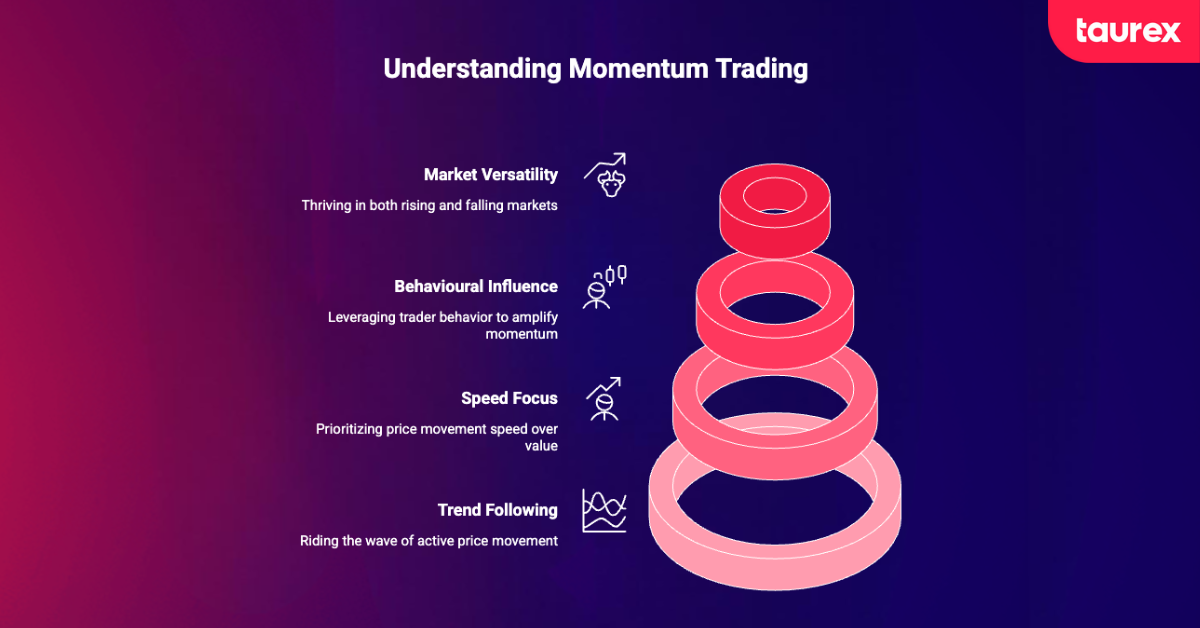
At its core, momentum trading strategies focus on the speed of price movement rather than value. It does not matter whether a pair like EUR/USD looks cheap or expensive. What matters is how fast the price is moving and whether that momentum is increasing.
There is also a behavioural side. Strong moves often attract more traders, which can push the price further in the same direction until momentum fades. This is why momentum trading can work in both rising and falling markets.
How Does Momentum Trading Work In Forex?
The Forex market is well-suited for momentum trading because of its size, liquidity, and constant activity. Trends can develop smoothly and last longer than in many smaller markets.
Since the Forex market runs 24 hours a day, there is always new price movement forming across different sessions. Strong momentum is often seen during major news events like inflation data, employment reports, or central bank decisions.
In practice, momentum trading in Forex is about reacting to strong moves instead of predicting them.
For example, if the European Central Bank delivers a more aggressive policy statement than expected, EUR/USD may rise quickly. A momentum trader does not try to anticipate this move. Instead, they wait for the move to begin, confirm that momentum is building through technical analysis, and then look for an entry point after a brief pullback within the new trend.
A simple momentum trading example could look like this: EUR/USD breaks above a recent resistance level during the London and New York overlap, RSI moves above 50, and MACD crosses above its signal line. Instead of buying immediately after the breakout candle, the trader waits for a small pullback, checks that the pair is still holding above the breakout level, and then enters with a stop-loss below the recent swing low.
The sequence looks like this:
- Spot the trend by scanning a momentum trading chart for a clear directional move.
- Confirm momentum with indicators like RSI, MACD, or volume.
- Enter on a pullback rather than chasing the very top of the move.
- Exit when momentum fades, signalled by indicators flattening out or reversing.
This process is less about predicting where price “should” go and more about responding to what price is already doing. That distinction is what makes momentum in trading accessible for beginners who may not yet have deep experience with fundamental analysis. On Taurex, you can access all of these indicators directly on our charts, which makes it straightforward to follow this process from a single interface.
What Are The Key Momentum Trading Indicators?
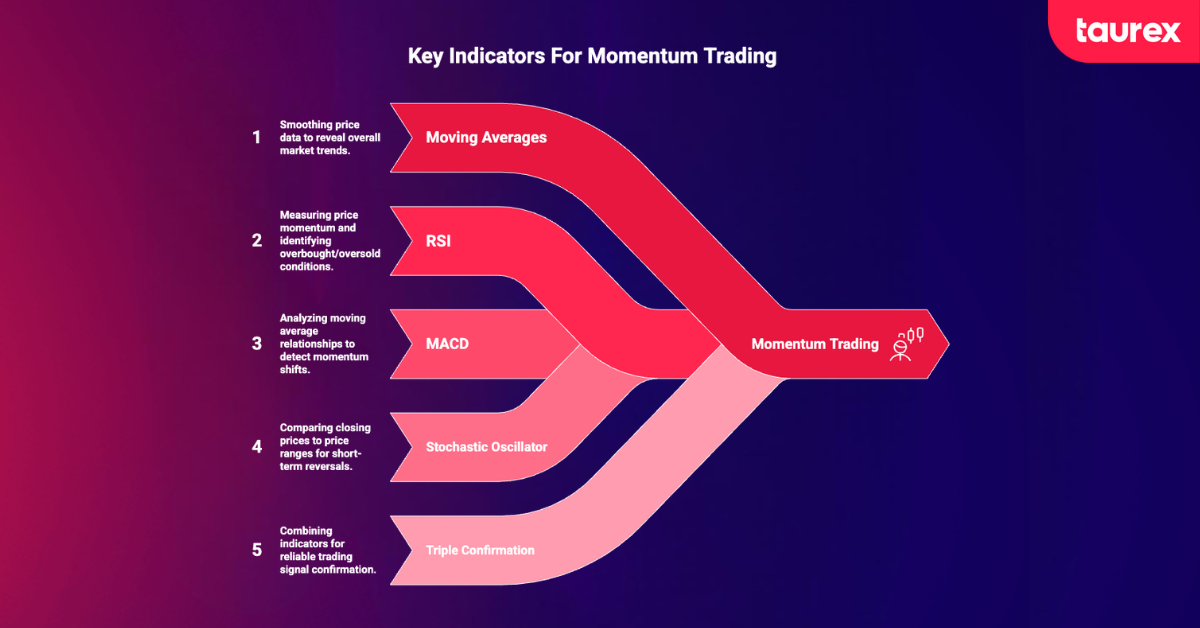
No single indicator gives a complete picture of momentum. That is why traders often combine two or more momentum trading indicators to confirm a setup before entering a trade.
Moving Averages
Moving averages help identify the overall trend by smoothing price movement. The most commonly used are the 50 and 200-period exponential moving averages.
When the 50 EMA crosses above the 200 EMA, it signals a potential shift to bullish momentum. When it crosses below, it suggests bearish momentum. Because EMAs react faster to recent price changes, they are widely used in momentum trading strategies.
Relative Strength Index (RSI)
RSI is a momentum indicator that moves between 0 and 100. Values above 70 can suggest strong upward pressure, while values below 30 can suggest strong downward pressure.
Most traders use the 14-period setting. In momentum trading, an RSI above 50 supports bullish momentum, while an RSI below 50 supports bearish momentum. Traders also use a divergence trading strategy, looking for cases where price moves in one direction but RSI fails to confirm it, which can signal weakening momentum.
MACD
MACD measures the relationship between two moving averages, usually the 12 and 26 EMA. A signal line is added to help identify changes in momentum.
When the MACD line crosses above the signal line, it suggests bullish momentum is building. When it crosses below, it suggests bearish momentum. The histogram helps show whether momentum is strengthening or fading.
Stochastic Oscillator
The Stochastic Oscillator compares the closing price to recent price ranges and moves between 0 and 100. Readings above 80 suggest overbought conditions, while readings below 20 suggest oversold conditions.
It is often more sensitive in ranging markets and can help spot short-term reversals. The most common setting is 14, 3, 3.
Using Indicators Together
A “triple confirmation” approach, requiring signals from MACD, RSI, and the Stochastic simultaneously, helps filter out false signals. This combination works well on 15-minute, 30-minute, and 1-hour timeframes, making it practical for day trading strategies as well.
What Factors Affect Momentum Trading?
Before applying any momentum trading strategy, it is important to understand the conditions that can strengthen or weaken its effectiveness. Market structure, risk control, and economic events all play a key role in how momentum behaves.
Market Environment
Momentum trading strategies thrive in trending, volatile markets and struggle in sideways ones. Markets consolidate most of the time, and during those periods, momentum signals have little to offer. That is a critical point for beginners: before you apply any momentum indicator, you need to assess whether the market is actually trending.
The most reliable momentum conditions tend to appear during major session overlaps, particularly when London and New York trading hours coincide, and around high-impact news releases.
Risk Management
Even when momentum signals look clean, reversals happen. Position sizing is your first line of defence. We suggest risking no more than 1 to 2 per cent of account equity on any single trade, and always placing a stop-loss before entering.
A minimum 1:2 risk-to-reward ratio is a sensible baseline, though many traders target 1:3 when the setup allows it. Trailing stops can help lock in gains during strong trend moves without capping your upside too early.
Information And Analysis
Economic calendars are non-negotiable tools for any momentum trader. High-impact events like rate decisions, Non-Farm Payrolls, and CPI releases can dramatically accelerate a trend or reverse it entirely. Consider this momentum trading strategy example: a surprise tariff announcement in October 2025 caused $20 billion in long positions to be liquidated within hours.
Momentum can vanish that quickly, so awareness of scheduled events is not optional. Taurex provides an integrated economic calendar so traders can stay informed about upcoming events without leaving their trading environment.
What Are The Pros And Cons Of Momentum Trading?
Like any trading strategy, a momentum trading strategy comes with clear strengths and genuine risks. Weighing both before committing capital is part of the discipline.
| Pros | Cons |
| Potential for large moves as strong trends can last hours or days | Risk of sudden reversals that can quickly turn profitable trades into losses |
| Simple, technical approach that does not require deep fundamental analysis | High drawdown risk in extreme market conditions if risk is not controlled |
| Clear signals using indicators like RSI, MACD, and moving averages | Trading costs can increase due to frequent entries and exits |
| Short holding periods, so capital is not locked in for long | False breakouts can lead to losing trades if confirmation is weak |
| Structured rules help reduce emotional decision-making | Requires constant attention and can be mentally demanding |
How To Start Momentum Trading
Getting started does not require a complex system. It requires a clear process, discipline, and consistent application. Here is a practical four-step framework, and if you are looking at broader Forex trading strategies for beginners, this fits naturally alongside other approaches.
1. Identify A Strong Trend In The Market
Begin by scanning major pairs like EUR/USD, GBP/USD, and USD/JPY for a clear directional move. You are looking for prices consistently printing higher highs and higher lows in an uptrend, or lower lows and lower highs in a downtrend.
Use the 50 EMA and 200 EMA as baseline filters: consider bullish momentum trading setups only when the price is trading above both.
2. Confirm Momentum With Key Indicators
Apply at least two confirming indicators before placing a trade. A solid buy setup might show RSI above 50, a bullish MACD crossover, and the Stochastic above 50.
This triple-confirmation approach filters out many false signals that would trap a trader relying on a single indicator. Think of it as requiring multiple witnesses before acting.
3. Enter Trades On Pullbacks
Rather than chasing a pair that has already moved significantly, wait for a brief pullback within the trend. When that pullback begins to stall and momentum indicators show the move is resuming, that is typically a more favourable entry point.
This approach offers a better risk-to-reward ratio than buying at the very top of a leg, and it gives your stop-loss a logical level to sit below.
4. Manage Risk On Every Trade
Place a stop-loss just below the most recent swing low for buy trades (or above the recent swing high for sells) before entering the position. Set a profit target at a minimum of twice the stop-loss distance for a 1:2 risk-to-reward ratio.
Momentum can reverse quickly, especially during unexpected news, so skipping this step is not a shortcut; it is a liability.
What Are The Risks of Momentum Trading?
Momentum trading strategy can be effective, but it also comes with important momentum trading risks that traders need to understand before using it in live markets. Most losses happen when traders ignore these risks or apply the strategy in the wrong conditions.
Trend reversals
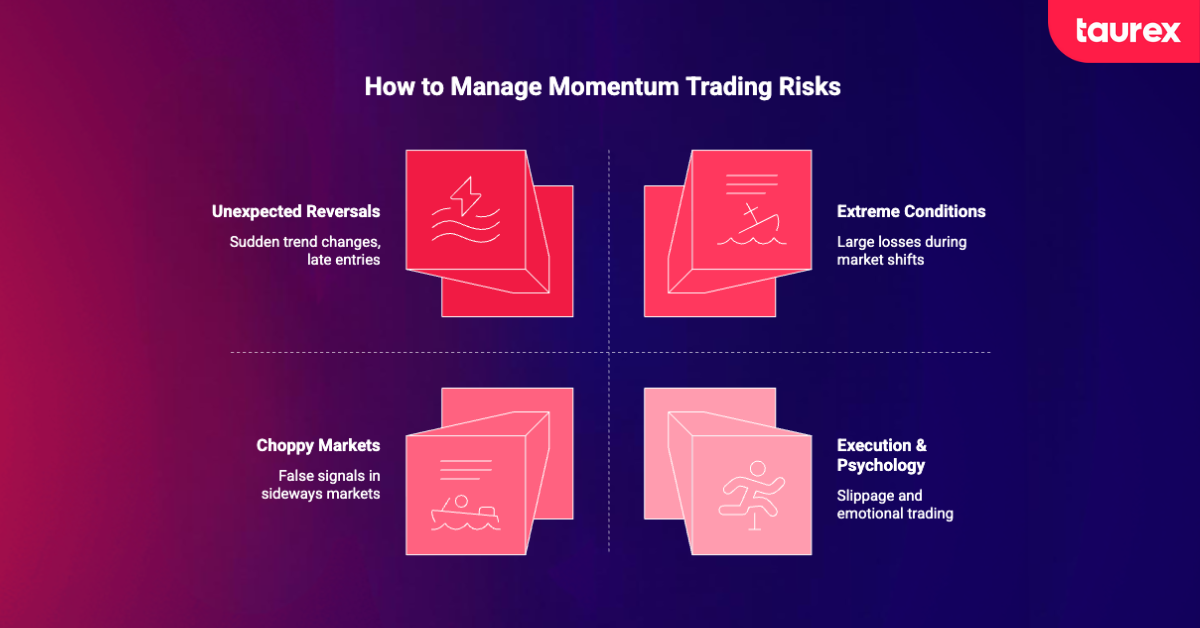
Momentum trades can reverse suddenly, especially during unexpected news or geopolitical events. Entering when indicators like RSI are already above 80 or Stochastic is overbought can also mean you are joining the move too late.
Choppy market conditions
Momentum trading works best in clear trends. In sideways or range-bound markets, indicators often give false signals, which can lead to repeated losing trades if setups are forced.
Slippage risk
Because momentum entries happen during fast price movement, the execution price may differ from the expected entry. This is common in volatile Forex pairs and can affect overall profitability.
Psychological pressure
Momentum trading strategy requires quick decisions and constant attention. This can lead to overtrading, closing trades too early, or chasing losses after a losing position.
Large drawdowns in extreme conditions
While momentum strategies can be effective, they have historically experienced significant drawdowns during major market shifts, in some cases reaching very large losses.
Conclusion
Momentum trading is a simple but powerful way to trade Forex by following strong market moves instead of predicting them. It works best in trending conditions, but it also requires discipline, confirmation, and strict risk management to handle sudden reversals and market noise.
If you want to practice momentum trading in real market conditions without risk, open a demo account with Taurex and test your strategy step by step before trading live.
FAQ
What is momentum trading?
Momentum trading is a strategy that enters positions in the direction of an existing strong price move. It focuses on price action and technical indicators rather than fundamental analysis, based on the idea that strong trends tend to persist.
Is momentum trading suitable for day traders?
Yes, it is particularly popular among day traders because short-term Forex trends can be captured within a single session on 15-minute, 30-minute, or 1-hour charts. It does require active monitoring during market hours.
Is momentum trading suitable for beginners?
It can be, provided you have a clear plan and strict risk management in place. We suggest practising on a demo account first, becoming comfortable with one or two indicators, and never risking more than 1 to 2 per cent of your account on any single trade. Familiarising yourself with key Forex trading terms before going live also helps. Taurex offers a free demo account where you can apply momentum strategies in real market conditions without risking any capital.
What timeframes work best for momentum trading?
Most momentum traders use 15-minute to 1-hour charts for short-term trades, or daily charts for medium-term trends lasting days to weeks. The right timeframe depends on your trading schedule and how actively you can monitor positions.
What is swing trading vs momentum trading?
Swing trading vs momentum trading comes down to holding period, entry logic, and trade management. Swing trading usually holds positions for several days and allows deeper pullbacks, while momentum trading focuses on faster moves and exits when the strength behind the price move starts to fade.
Is momentum trading profitable?
Momentum trading can be profitable when used in the right market conditions with strong risk management. However, no strategy works all the time. The key is knowing when momentum conditions are strong enough to trade and when to stay out of the market.
How do you identify strong momentum in the market?
Look for sustained higher highs and higher lows (uptrend) or lower lows and lower highs (downtrend) on the chart. Confirm with RSI above 50, a bullish MACD crossover, and increasing volume for a buy setup. A clean momentum trading chart pattern with multiple confirming indicators is your strongest signal.
What is the difference between momentum trading and trend trading?
Both follow price direction, but momentum trading emphasises the speed and strength of a move using oscillators like RSI and MACD. Trend trading focuses more on the overall direction using tools like moving averages and trendlines, with less emphasis on precise entry timing.
Can momentum trading be used in all market conditions?
No. Momentum strategies work best in trending, volatile markets. In sideways or ranging conditions, momentum indicators tend to produce frequent false signals, and applying the strategy in those environments can generate consistent losses.
How much capital do you need to start momentum trading?
There is no universal minimum, and many regulated brokers allow you to open an account with relatively modest amounts. The focus should be on proper position sizing rather than account size itself: limit risk to 1 to 2% of equity per trade, regardless of how much you start with.
Do professional traders use momentum strategies?
Yes. Hedge funds and institutional traders have used momentum strategies for decades. The momentum premium is a consistent, structural feature of financial markets rather than a temporary pattern.
How do you manage risk in momentum trading?
Always use a stop-loss placed at a technically significant level before entering the trade. Maintain a minimum 1:2 risk-to-reward ratio. Limit risk per trade to 1 to 2 per cent of account equity and consider trailing stops to protect gains during strong trend-following moves.