
Imagine EUR/USD closes on Friday at 1.1000. When the market opens again on Monday, the price starts at 1.1050 instead of moving there step by step. This sudden jump creates a space on the chart where no trading happened. That space is called a price gap.
Price gap trading is a strategy built around these gaps. Traders look for opportunities based on how the price reacts after the market opens. In Forex, this usually happens between Friday’s close and Monday’s open.
In this guide, you will learn the main types of price gaps, what gap trading is, common gap trading strategies, and how to manage risk when trading them.
What Is A Price Gap and Why Does It Happen in Forex Trading?
A price gap happens when the market opens at a much higher or lower price than where it previously closed, leaving an empty space on the Forex chart where no trades took place.
In stock markets, gaps happen often because trading stops every day and starts again the next morning. In Forex, gaps are less common because the market runs almost continuously from Sunday evening to Friday night. Most Forex gaps happen over the weekend, between Friday’s close and Monday’s open.
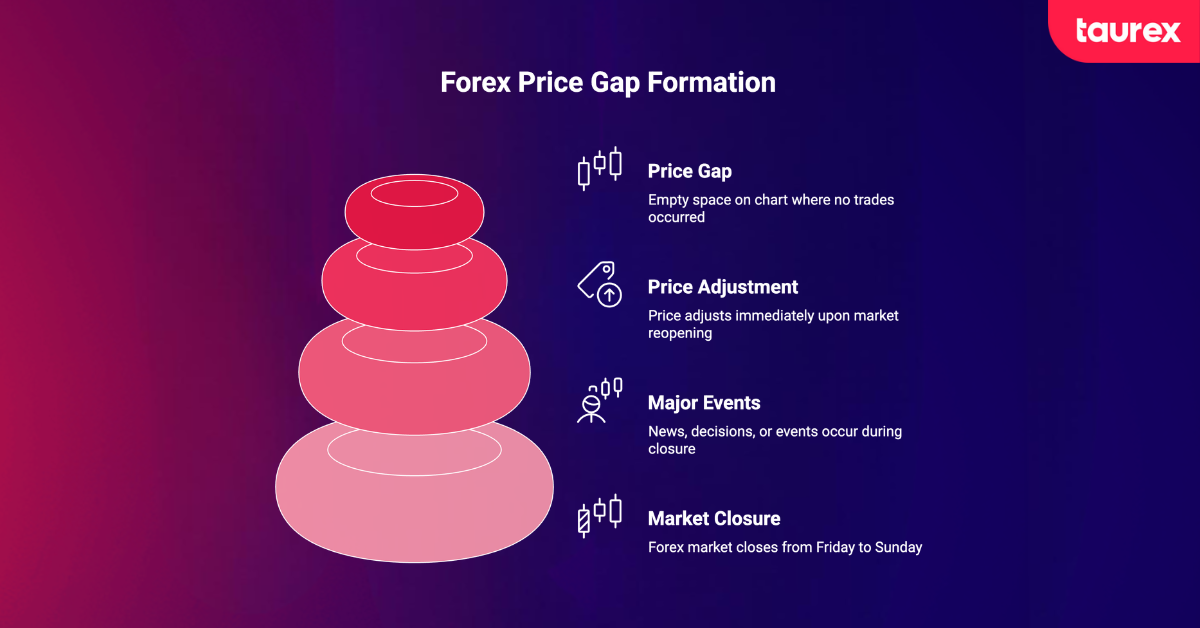
These gaps are usually caused by major news, central bank decisions, economic data, or geopolitical events that affect how traders view a currency pair while the market is closed. When trading resumes, the price adjusts immediately, creating the gap.
Most of the weekend gaps in major Forex pairs fill within the first two trading days. This means price often moves back to close the gap, which is the idea behind many gap trading strategies. However, not every gap fills, and some can continue in the same direction for much longer.
What Is the Fair Value Gap in Forex Trading?
A fair value gap, often called an FVG, is a price imbalance that forms when the market moves strongly in one direction and leaves behind an area with limited overlap between candles. In simple terms, it shows a zone where the price moved too quickly, leaving an inefficient area on the chart.
A common fair value gap forms as a three-candle pattern. The middle candle creates the strong move, while the candles on either side do not fully overlap that price range with their wicks. This gap between the first and third candles is the area that traders watch.
In Forex trading, fair value gaps are often used to identify possible pullback zones. The idea is that the price may return to the gap area before continuing in the same direction. For example, after a strong bullish move, the price may later pull back into the fair value gap before moving higher again. In a bearish setup, the price may retrace upward into the gap before continuing lower.
Fair value gaps are closely linked to ICT, or Inner Circle Trader, concepts and are often discussed alongside liquidity, market structure, and order block trading. Traders who already use order blocks may find FVGs useful because both concepts focus on areas where institutional activity may have influenced price movement.
However, a fair value gap should not be treated as a guaranteed reversal or continuation signal. Like any technical concept, it works best when confirmed with broader market structure, trend direction, volume, support and resistance, or another trading signal. Traders should also use a clear stop-loss and avoid entering only because the price has reached an FVG.
4 Main Types of Price Gaps You Need to Know
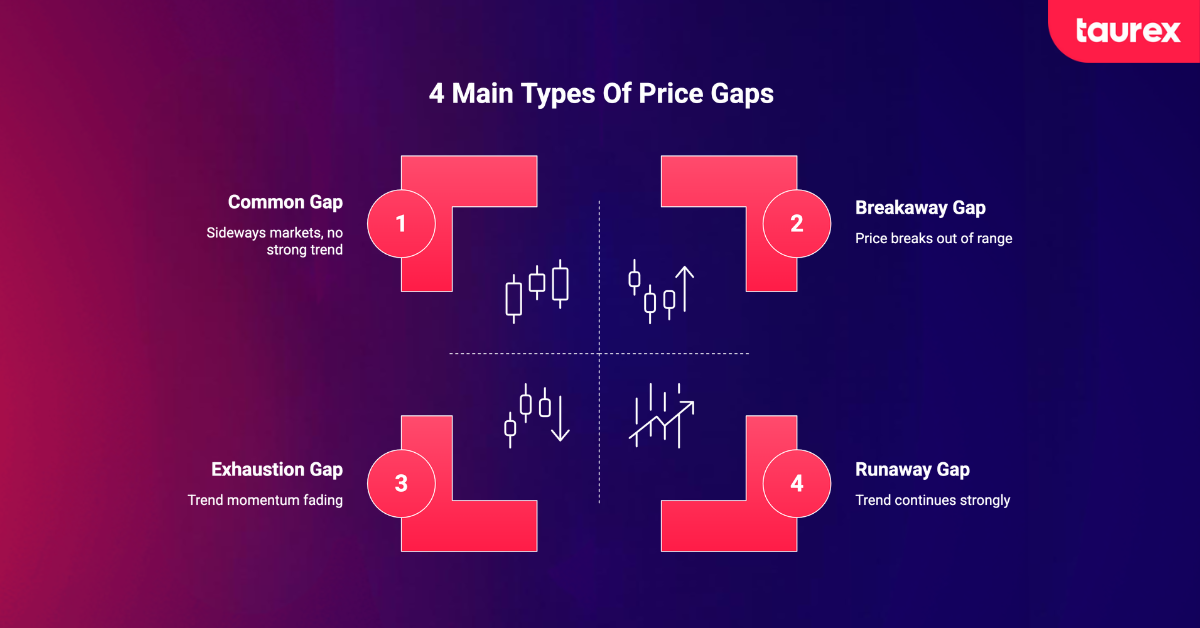
Not all price gaps mean the same thing. Each type shows something different about market strength and direction. Understanding the difference helps you choose the right approach to trade gaps.
Common Gap
A common gap is the most frequent type. It usually appears in sideways or range-bound markets where there is no strong news or clear trend.
These gaps often fill quickly, sometimes on the same day or within one to two trading sessions. On their own, they are not strong trading signals and usually need extra confirmation from other technical tools.
Breakaway Gap
A breakaway gap happens when the price breaks out of a trading range or moves through an important support or resistance level.
This often signals the start of a new trend and is usually supported by stronger volume. These gaps are normally traded in the direction of the breakout, not against it.
Runaway Gap
A runaway gap, also called a continuation gap, forms in the middle of an existing trend. It shows that the current trend is still strong and has room to continue.
This type of gap confirms that buyers or sellers remain in control, and momentum is still building. Some traders also use it to estimate how much further the trend may move. Unlike common gaps, runaway gaps usually stay open for longer and often do not fill until the overall trend starts to reverse.
Exhaustion Gap
An exhaustion gap appears near the end of a strong trend and can signal that momentum is starting to fade. It often happens after a long move up or down, when buyers or sellers are losing strength.
Signs like RSI or MACD divergence, extreme market sentiment, or reversal patterns can help confirm it. Some traders use exhaustion gaps to prepare for a possible reversal, but waiting for extra confirmation is important before entering against the trend.
Pros and Cons of Price Gap Trading in Forex
| Pros | Cons |
| Gaps are easy to spot on the chart | Most Forex gaps only happen over the weekend, so setups are less frequent |
| No complex indicators are needed to identify them | Monday opens often have wider spreads and lower liquidity |
| Many gaps tend to fill, giving traders a probability-based setup | Not every gap fills, especially breakaway and runaway gaps |
| Can be used across major Forex pairs | Strong gaps can move far beyond your stop-loss |
| Many trades resolve within one or two sessions | Fast market moves can lead to emotional and poor entries |
5 Best Gap Trading Strategies for Forex Traders
Not every gap should be traded the same way. The right strategy depends on the type of gap, the market context, and whether the price is likely to continue or reverse.
Gap And Go Trading Strategy
The gap and go strategy is a momentum setup where you trade in the same direction as the gap. It works best with breakaway gaps, where strong momentum suggests the trend will continue.
Entry: Enter in the direction of the gap after the market opens, and the price shows that the gap is holding. Many traders wait 10 to 15 minutes to avoid false moves at the open. Taurex’s MT4 and MT5 platforms support pending orders, including buy stops and sell stops, which can be set before the Monday open. This allows traders to plan gap-and-go entries instead of chasing price once the market starts moving.
Stop-loss: Place it below the low of the first gap candle for a gap up, or above the high for a gap down.
Target: Aim for at least a 1:2 or 1:3 risk-to-reward ratio.
If the price quickly moves back against the gap, it is usually a sign to stay out rather than force the trade.
Gap Fill Strategy
The gap fill strategy is a mean-reversion setup where you expect the price to move back and close the gap. In simple terms, you are trading for price to return to Friday’s closing level.
This works best with common gaps and exhaustion gaps, especially when the gap opens on low volume, and there is no strong reason for the price to keep moving in the same direction.
- Entry: Sell after a gap up or buy after a gap down once the price starts showing signs of moving back toward the previous close.
- Stop-loss: Place it beyond the gap’s extreme point, usually near the Monday opening price.
- Target: Friday’s closing price, where the gap would be filled.
Most gaps eventually fill, which is why this strategy is widely used. However, not every gap closes, so risk management is still essential.
Breakaway Gap Trading Strategy
With breakaway gap trading, you are riding the new trend rather than betting against it. This setup pairs well with gaps that form at key technical levels, like broken trendlines or breached support and resistance zones, and that are backed by strong volume.
- Entry: After confirmation that the gap is not filling. Price needs to hold above or below the gap zone.
- Stop-loss: Place it inside the gap zone itself, below the open for a gap up or above the open for a gap down.
- Target: The next significant resistance or support level, with a minimum risk-to-reward ratio of 1:2.
The cardinal rule here: do not fade a breakaway gap. These are trend-initiating events, and trying to fight them often leads to a losing position.
Exhaustion Gap Strategy
This is a contrarian strategy where you trade against the direction of the gap, expecting the market to reverse. It works when a strong trend is losing momentum, and the gap appears near the end of that move.
Before using this setup, make sure the trend has been running for a while and shows signs of slowing down. This could include RSI divergence, weaker momentum, or reversal candlestick patterns.
- Entry: Enter against the gap direction only after confirmation, such as a bearish engulfing candle after a gap up or bullish confirmation after a gap down.
- Stop-loss: Keep it tight, just beyond the gap’s extreme point. If the price keeps moving in the gap direction, exit quickly.
- Target: Aim for a move back to the previous support or resistance level, or a nearby Fibonacci retracement zone.
The most important rule here is patience. An exhaustion gap can look like a reversal, but if it turns into a continuation move instead, entering too early can be costly.
End-Of-Day Gap Trading
This approach involves taking a position at the end of Friday’s session based on anticipated weekend catalysts, such as a geopolitical event, an upcoming central bank announcement, or a major data release scheduled for the weekend.
- Entry: Late Friday, based on the expected direction of the gap.
- Stop-loss: Wider than intraday trades, percentage-based to account for weekend volatility.
- Target: Exit at Monday’s open once the gap materialises.
This is the highest-risk approach among all gap trading strategies. Sizing conservatively is critical because the weekend gap can just as easily go against your thesis.
Real-World Example in Gap Trading
The EUR/USD gap on July 1, 2024, is a good example of how the same move can be traded in different ways depending on strategy and timeframe.
EUR/USD was trading in a narrowing wedge before the first round of the French election. It closed around 1.0713 on Friday and opened near 1.0744 on Sunday evening, creating a clear gap.
A trader using a gap fill strategy could have sold early on Monday, expecting the price to return and fill the gap at 1.0713. In this case, that move played out within the same trading session.
However, another trader could have viewed this as a breakaway gap. Since the price broke above a key technical structure on a major news event, they may have waited for the gap to stabilise and then gone long. Over the following weeks, EUR/USD continued higher, eventually reaching around 1.1175, a move of about 4.35%.
The key takeaway is simple: the same gap can mean different things. Your outcome depends on the context, your strategy, and how you manage risk.
How to Identify Gaps Before the Market Opens
Spotting a gap before the session officially opens gives you time to plan your entry, set your order types, and size your position properly, rather than scrambling after the opening bell.
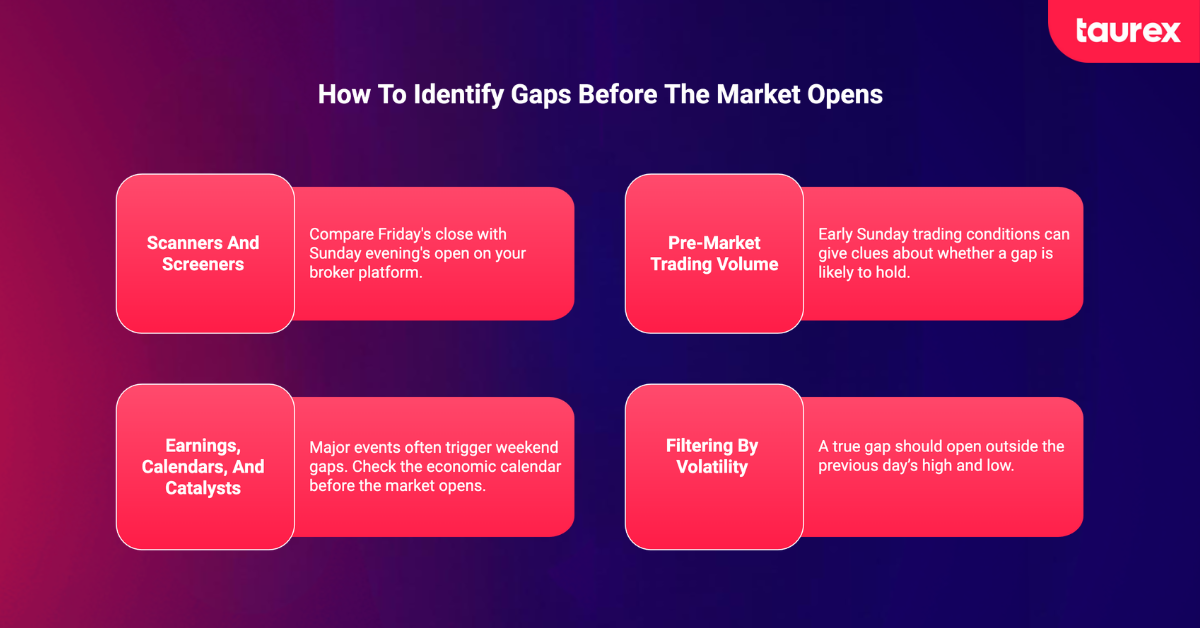
Using Scanners And Screeners. You can spot gaps by comparing Friday’s close with Sunday evening’s open directly on your broker platform or charting tools. On Taurex, this can be done by reviewing price differences across sessions on major pairs.
Traders often focus on gaps above 20–50 pips on major currency pairs, as larger gaps tend to create stronger setups.
Pre-Market Trading Volume. Early Sunday trading conditions can give clues about whether a gap is likely to hold or fade. Higher activity and tighter movement usually suggest stronger continuation.
In Forex, where volume is decentralised, traders instead focus on spread behaviour and early price stability. Weak activity often leads to gap fades, while stronger activity supports continuation.
Earnings, Calendars, And Catalysts. Major events like central bank decisions, CPI, NFP, or geopolitical news often trigger weekend gaps. Always check the economic calendar before the market opens.
A gap supported by a clear news event is usually more reliable than one with no clear reason behind it. Understanding the Forex market hours and when different sessions open can also help you anticipate where the strongest reaction is likely to occur.
Filtering By Volatility And The Previous Day’s Range. A true gap should open outside the previous day’s high and low. If the price is still inside that range, it is usually just normal market noise.
Focus on liquid pairs like GBP/USD and USD/JPY, where price movement is strong enough to create meaningful gaps.
Risk Management in Forex Gap Trading
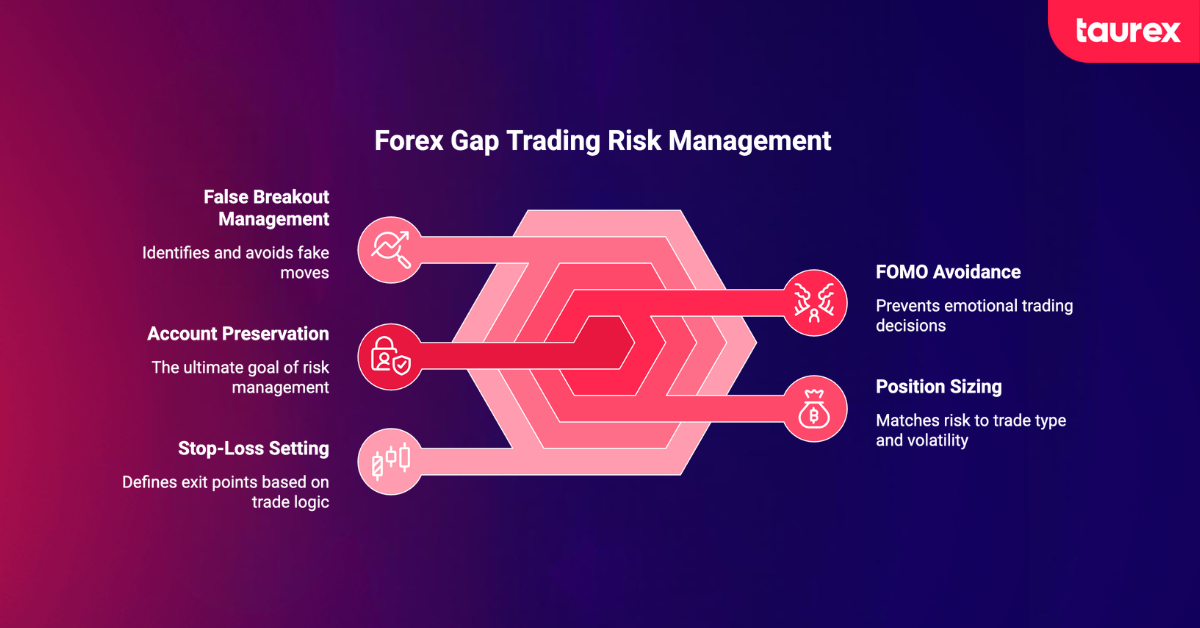
Gap trading risk management is what separates disciplined traders from those who blow through their accounts chasing Monday morning volatility. Sudden reversals, false breakouts, and FOMO driven entries are the most common pitfalls, and the following rules help address each one.
Setting Proper Stop-Loss
Your stop-loss should be placed at a level that invalidates your trade idea, not at a random pip distance.
For common gap fill setups in calmer conditions, you can use tighter stops, around 0.25% below or above entry. For breakaway gaps in more volatile conditions in Forex, wider stops of around 0.5% to 0.75% are often more realistic.
Some traders also use time-based stops. If a gap fill trade is not moving in the expected direction within the first 30 to 60 minutes, it may be better to exit or reassess instead of holding and hoping.
Managing False Breakouts And Fake Fills
False breakouts happen when the price quickly moves through a gap level and then reverses just as fast. This is common around the market open, when volatility and spreads are at their highest.
One simple way to reduce this risk is to wait 10 to 15 minutes after the open before entering a trade. This gives the initial volatility time to settle.
It is also important to wait for a full candle close beyond the level, not just a wick or quick spike. A close provides stronger confirmation that the move is real.
If price moves back through the gap’s starting point and does not hold, it is usually a sign the setup has failed. In that case, it is better to exit early rather than treat it as a gap fill, because it may actually be turning into a breakaway move.
Sizing Your Position Based On Gap Type And Volatility
Position sizing in gap trading should always match the type of gap and the level of volatility in the market.
A common guideline, referenced by both DayTrading.com and Pocket Option, is to risk no more than 1–2% of your total account on a single trade. For higher-risk setups like exhaustion gaps, it is usually better to reduce your risk even further.
Breakaway gaps with strong volume confirmation may justify slightly larger confidence, but even then, risk should remain controlled. The key is to first define your stop-loss using volatility measures like ATR, then calculate your position size based on that risk level.
In other words, you should size the trade based on risk, not adjust your stop-loss to fit your position. This is where understanding Forex trading rules around position sizing and margin can help you stay disciplined.
Avoiding FOMO in Gap And Go Setups
One of the biggest mistakes in gap and go trading is chasing price after it has already moved strongly at the open. By the time you enter late, the best part of the move is often already gone.
If your planned entry is missed, it is usually better to skip the trade. Chasing price often leads to a poor risk-to-reward setup and a stop-loss placed too far away to be practical.
A better approach is to wait for a second entry. After the initial gap move, the price often pauses or consolidates, creating a cleaner and lower-risk setup with a more logical stop-loss.
The key mindset is simple: not every gap needs to be traded. There will always be new opportunities.
Conclusion
Gap trading in Forex is all about understanding context, not just spotting price gaps on a chart. Some gaps signal reversals, others show strong continuation, and some simply get filled as the market stabilises after a move. The key is knowing the difference and applying the right strategy at the right time.
Success with gap trading comes down to three things: identifying the gap type correctly, waiting for confirmation before entering, and managing risk with discipline. Without these, even the best-looking setup can fail.
The fastest way to improve is to apply these concepts in real market conditions without risking capital.
You can open a demo account with Taurex to practise identifying gaps, testing different strategies, and refining your execution in live market conditions using real charts and price data.
FAQ
What is a gap in Forex trading?
A gap in Forex trading is a price discontinuity on a chart where the opening price of a new session differs meaningfully from the prior session’s close, with no trades recorded in between. Because the Forex market trades continuously from Sunday evening to Friday close, these gaps most commonly appear at the Monday open after the weekend market closure.
Is gap trading suitable for beginners?
Gap trading can be accessible to beginners, but it does require a solid understanding of how to read charts, gap types, and risk management. We suggest starting with a demo account to paper trade gap strategies and focusing initially on the simpler gap fill approach on major pairs.
More complex approaches like breakaway gap trading or exhaustion gap strategies are generally better suited for traders who have some experience identifying trend context and managing positions under pressure.
Why is gap trading risky?
Gap trading carries several specific risks. Not all gaps fill, and those that do not can extend well beyond a planned stop-loss. Spreads are often wider at the Monday open in Forex, which reduces the profitability of fill trades. FOMO-driven entries into gap and go setups frequently lead to poor risk-to-reward ratios. And false breakouts around gap zones can trigger stop-losses before the anticipated move occurs.
Do all gaps fill?
No. Common and exhaustion gaps often fill more frequently, but breakaway and runaway gaps can continue for long periods without filling. Some gaps may take days, weeks, or may not fill at all if a strong trend develops.
How can I take advantage of a gap during Forex trading?
The first step is identifying the gap type: common, breakaway, runaway, or exhaustion. Then choose a strategy that matches. For breakaway and runaway gaps, trading in the direction of the gap tends to align with the momentum. For common and exhaustion gaps, trading against the gap (fading it) is the more typical approach. Always confirm with volume context, define a stop-loss before entering, and target a minimum 1:2 risk-to-reward ratio.
What happens when a gap is filled, and the price keeps going?
When a gap fills, but price continues beyond the prior close rather than reversing, it often means the original gap was actually a breakaway. The fill was temporary, and the trend has resumed. Traders in a fill position should exit at their planned fill level and reassess whether a gap and go setup has now formed in the direction of the original gap. Sticking to the original trade plan rather than improvising on the fly is what protects you in this scenario.