
Choosing a Forex broker means looking beyond spreads and trading platforms. You also need to know who regulates the broker and what protections that regulation provides.
There is no single global Forex regulator, so licensing requirements vary by jurisdiction. This guide covers the main Forex broker licences and explains how to verify a broker’s regulatory status.
What Is a Forex Broker Licence and How Does It Work?
A Forex broker licence allows a specific legal entity to provide Forex trading and CFD services under the rules of a particular jurisdiction. To obtain and maintain a licence, a broker may need to meet requirements for capital, client funds, financial reporting, risk disclosures, and business conduct.
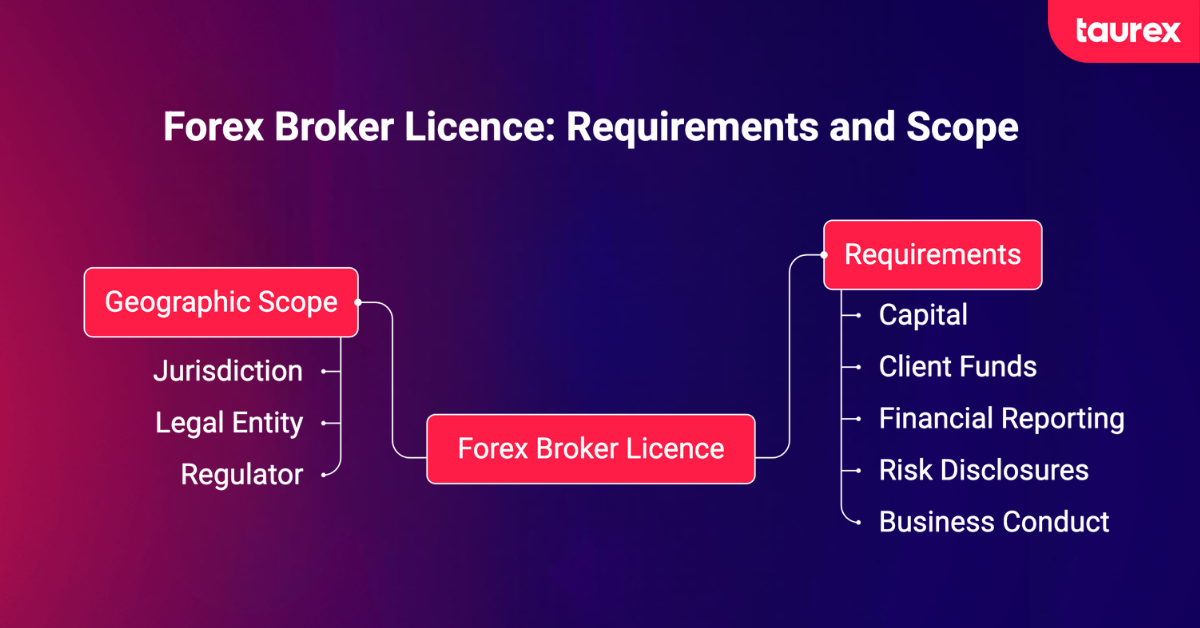
The licence also has a geographic scope. A broker authorised in one country is not automatically authorised to serve clients everywhere. That is why you should check which legal entity you are contracting with and which regulator supervises it.
What Are Major Forex Broker Licences and Regulators?
Forex regulators differ in their capital, conduct, reporting, and investor protection requirements. The FCA, CySEC, ASIC, and FSCA are among the regulators that frequently appear when comparing Forex broker licences.
FCA Licence (United Kingdom)
The Financial Conduct Authority (FCA) regulates UK investment firms under a framework influenced by MiFID II. FCA-regulated brokers must follow rules covering client money, capital, reporting, conduct, and retail trading conditions. Retail leverage is generally capped at 30:1 for major currency pairs and 20:1 for non-major pairs.
Eligible clients may also receive protection through the Financial Services Compensation Scheme (FSCS) if a regulated firm fails, subject to the scheme’s eligibility rules and limits. FCA rules also restrict certain incentives and promotions for retail CFD clients.
CySEC Licence (Cyprus / EU)
The Cyprus Securities and Exchange Commission (CySEC) regulates investment firms authorised in Cyprus. A Cyprus Investment Firm can provide services across the European Economic Area under the applicable EU passporting framework, although the specific rules depend on the firm’s authorisation and where it provides services.
CySEC-regulated firms must meet capital, reporting, client fund, and conduct requirements. Eligible retail clients may also receive protection through the Investor Compensation Fund, with coverage of up to €20,000 per client, subject to the scheme’s rules and eligibility requirements.
ASIC Licence (Australia)
The Australian Securities and Investments Commission (ASIC) regulates Forex and CFD providers through the Australian Financial Services Licence (AFSL) framework. Retail CFD trading is subject to product intervention measures, including leverage limits ranging from 30:1 for major currency pairs to 2:1 for cryptocurrency CFDs.
Retail clients are also covered by negative balance protection and a 50% margin close-out rule under the applicable requirements. Australia does not have a statutory investor compensation scheme for clients of failed investment firms, although eligible financial services complaints can be taken to the Australian Financial Complaints Authority (AFCA).
FSCA Licence (South Africa)
The Financial Sector Conduct Authority (FSCA) regulates Forex brokers and other financial services providers under South Africa’s financial services framework. Firms must meet requirements covering licensing, financial resources, reporting, conduct, and client protection.
The exact requirements depend on the services and licence category involved. South Africa does not have a statutory investor compensation scheme for clients of failed financial services firms, so dispute resolution and recovery options depend on the circumstances and applicable legal processes.
DFSA Licence (Dubai / DIFC)
The Dubai Financial Services Authority (DFSA) regulates financial firms operating in or from the Dubai International Financial Centre (DIFC), which has its own legal and regulatory framework. Forex brokers operating under the DFSA must meet requirements covering capital, governance, client assets, risk management, and conduct.
Retail trading conditions are subject to DFSA rules, including leverage requirements and risk disclosures. The DIFC framework does not operate a retail investor compensation scheme equivalent to the UK’s FSCS, so traders should check which protections apply to the specific firm and account.
CFTC and NFA Registration (United States)
Forex brokers serving US retail clients operate under a stricter regulatory framework involving the Commodity Futures Trading Commission (CFTC) and National Futures Association (NFA). Firms acting as counterparties to retail Forex transactions generally need to meet the relevant registration and capital requirements.
US retail Forex rules limit leverage to 50:1 for major currency pairs and 20:1 for other pairs. They also include specific requirements for margin, reporting, and trade execution. Hedging the same currency pair is generally not permitted in a single account, and the first-in, first-out (FIFO) rule applies to certain positions.
Other Major Forex Regulatory Licences
Other jurisdictions also license Forex brokers, including Seychelles, Mauritius, Vanuatu, and Belize. Their licensing requirements, capital rules, leverage limits, and investor protections differ from those in the UK, EU, Australia, and the US.
Some offshore jurisdictions have lower entry requirements and fewer restrictions on retail leverage. However, the level of investor protection depends on the specific regulator and legal entity involved. Traders should therefore verify the broker’s exact licence rather than relying on broad claims such as “offshore regulated.”
Singapore’s Monetary Authority of Singapore (MAS), Japan’s Financial Services Agency (FSA), Canada’s Canadian Investment Regulatory Organization (CIRO), and the UAE’s Securities and Commodities Authority (SCA) are other regulators worth recognising when comparing Forex broker licences.
How Do Major Forex Broker Licences Differ?
The main differences between Forex regulatory regimes relate to capital requirements, client fund protection, leverage limits, negative balance protection, compensation schemes, and reporting obligations. The exact requirements depend on the regulator, licence type, business model, and client classification.
| Factor | FCA | CySEC | ASIC | FSCA | DFSA | CFTC/NFA |
| Jurisdiction | UK | Cyprus / EEA | Australia | South Africa | Dubai (DIFC) | United States |
| Capital requirements | Capital adequacy rules | Varies by authorisation | Varies by licence and business model | Solvency-based requirements | Varies by licence category | High minimum capital requirements |
| Retail leverage on major pairs | 30:1 | 30:1 | 30:1 | Varies | Subject to DFSA requirements | 50:1 |
| Client fund segregation | Required under applicable CASS rules | Required under applicable rules | Required under applicable rules | Required under applicable rules | Required under applicable rules | Required under applicable rules |
| Negative balance protection | Applies to eligible retail clients | Applies to eligible retail clients | Applies to retail clients under applicable rules | Not generally mandated in the same way | Not generally mandated in the same way | Different regulatory framework |
| Compensation scheme | FSCS, subject to eligibility and limits | ICF, up to €20,000 for eligible claims | No statutory scheme | No statutory scheme | No equivalent retail scheme | No equivalent statutory scheme |
| Dispute resolution | Financial Ombudsman Service, where applicable | Applicable CySEC and legal processes | AFCA | FAIS Ombud | DFSA complaints process | NFA arbitration and other applicable processes |
How Do Forex Broker Licences Protect Traders?
Forex regulation can protect traders in several ways, although the exact safeguards depend on the regulator and legal entity.
- Segregated client funds: Brokers may be required to keep client money separate from their operating funds. This helps prevent client funds from being used for business expenses.
- Negative balance protection: Some regulators require this for eligible retail clients, preventing them from owing the broker more than the funds in their account.
- Capital requirements: Brokers must maintain sufficient financial resources to meet their obligations and manage financial risks.
- Reporting and oversight: Regulated brokers must meet ongoing reporting and conduct requirements and remain subject to regulatory supervision.
- Complaints procedures: Regulated firms generally have formal complaint processes, with external dispute resolution available in some jurisdictions.
Regulation does not cover normal trading losses, so understanding Forex trading rules and how client money is protected with safety of funds arrangements remains important.
How Can You Check a Forex Broker’s License?
- Find the licence details: Look for the broker’s legal entity name and licence number in its website footer, legal documents, or regulatory information.
- Search the official register: Check the regulator’s own database, such as the FCA Financial Services Register, ASIC registers, CySEC public register, or NFA BASIC.
- Check the authorisation: Confirm that the licence is current and covers the financial services the broker provides.
- Cross-check the details: Compare the registered address, phone number, and website domain with the information shown on the regulator’s register. A cloned website can use a genuine firm’s name and licence number.
- Identify the entity: Check which legal entity will hold your account. A licence held by another company in the same group does not automatically apply to your account.
Checking these details can also help you spot Forex scams that use fake or copied regulatory information.
Why Can the Same Forex Broker Have Multiple Licences?
A broker may operate through different legal entities because financial regulation is based on jurisdiction. The entity you trade with determines which rules and protections apply.
- Operating in different countries: A broker may need separate authorisations to serve clients in different jurisdictions.
- Meeting local requirements: Each regulator sets its own rules for capital, reporting, conduct, and client protection.
- Offering different leverage: Leverage limits can vary between entities. An entity subject to a 30:1 retail limit cannot offer the same terms as an entity operating under different rules.
- Providing different protections: Compensation schemes, negative balance protection, and other safeguards depend on the regulatory entity, not simply the broker’s brand name.
- Identifying the contracting entity: The legal entity named in your account agreement matters more than the regulatory logos displayed on a broker’s website.
For example, Taurex operates through separate entities in different jurisdictions, with the applicable regulatory details set out on our global regulations page.
What Should You Check Beyond a Forex Broker Licence?
A licence tells you about regulatory oversight, but it does not tell you everything about a broker’s trading conditions or services.
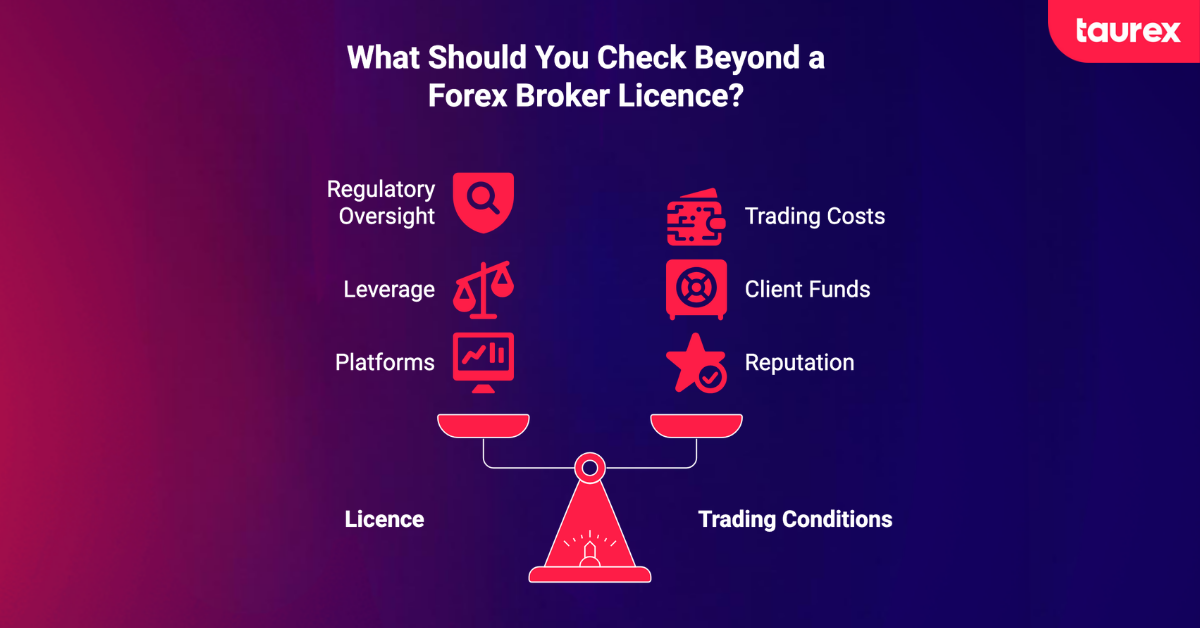
- Trading costs and spreads: Compare spreads, commissions, and overnight financing for the currency pairs you plan to trade, such as EUR/USD or GBP/USD.
- Leverage and margin requirements: These can vary between legal entities, even when they operate under the same broker brand.
- Client fund arrangements: Check how client money is held, whether it is segregated, and which entity is responsible for your account.
- Trading platforms and tools: Check whether the broker offers the platform and features you need. Common options include MT4 and MT5, which you can compare across different Forex trading platforms.
- Deposits and withdrawals: Review available payment methods, processing times, fees, supported currencies, and any withdrawal requirements.
- Reputation and complaints: Check the broker’s regulatory history, published warnings, complaints procedures, and any enforcement actions involving the relevant legal entity.
Which Regulatory Licences and Authorisations Apply to Taurex?
Taurex operates through separate legal entities, each subject to the rules of its relevant jurisdiction:
- Taurex Limited: Authorised and regulated by the UK Financial Conduct Authority (FCA) under FRN 816055.
- Taurex Global Limited: Regulated by the Seychelles Financial Services Authority (FSA) under licence SD092.
- Taurex Financial Services L.L.C.: Regulated by the UAE Capital Market Authority (CMA), formerly the Securities and Commodities Authority, under licence 20200000224. It holds a Category 5 – Ranking and Advice licence and is not authorised to hold client assets or client money.
| Entity | Regulator | License / reference | Role |
| Taurex Limited | UK Financial Conduct Authority (FCA) | FRN 816055 | Authorised and regulated UK entity |
| Taurex Global Limited | Seychelles Financial Services Authority (FSA) | SD092 | Issuer and seller of products on the main Taurex website |
| Taurex Financial Services L.L.C. | UAE Capital Market Authority (CMA), formerly SCA | 20200000224 | Category 5 license (ranking and advice) |
The trading conditions and protections available to clients depend on the entity they contract with. For example, UK retail clients are subject to the FCA’s leverage limits, while other jurisdictions may apply different requirements.
Ready to get started? Open a Forex trading demo account with Taurex and review the terms that apply to your account.
Final Thoughts
A Forex broker licence is an important starting point, but it does not tell you everything about a broker. The protections, leverage limits, and other trading conditions depend on the regulatory entity holding your account.
Before opening an account, verify the broker’s legal entity and licence on the regulator’s official register. Then compare the costs, execution, platforms, support, and other conditions that matter to you.
FAQ
What is a Forex broker licence?
A Forex broker licence is an authorisation from a financial regulator that allows a specific legal entity to provide Forex and CFD services. The requirements can cover capital, client funds, reporting, disclosures, and business conduct.
Which Forex broker licences are the most important?
The FCA, CySEC, ASIC, CFTC, NFA, FSCA, and DFSA are among the regulators traders may encounter when comparing Forex brokers. Each operates under its own rules for licensing, leverage, client protection, reporting, and supervision.
How do I check if a Forex broker is licensed?
Take the broker’s legal entity name and licence number and search for them in the regulator’s official register. Check that the authorisation is current, covers the services offered, and matches the firm’s registered address and website details.
Is FCA regulation better than CySEC regulation?
The FCA and CySEC operate under different regulatory frameworks, so neither should be treated as universally better. Both impose requirements on regulated firms, while specific protections such as compensation coverage and leverage limits depend on the applicable rules and client circumstances.
Does a Forex broker licence guarantee safety?
No. Regulation can reduce certain risks through capital requirements, client fund rules, and ongoing supervision, but it cannot eliminate market risk or guarantee that funds will be recovered immediately if a broker fails.
Can a Forex broker have multiple licences?
Yes. International brokers may operate through separate legal entities in different jurisdictions. The entity named in your client agreement determines which regulator, trading conditions, and client protections apply to your account.
Does regulation affect Forex leverage?
Yes. Leverage limits vary by jurisdiction and client classification. For example, UK and EU retail rules generally limit leverage on major currency pairs to 30:1, while the US regime allows up to 50:1 for major pairs.
What is the difference between a Forex licence and registration?
A licence generally authorises a firm to provide specified financial services under regulatory supervision. Registration can have a more limited purpose, such as registering a company or intermediary, and does not necessarily mean the firm is authorised to provide Forex services or hold client funds.
Can an offshore Forex broker be regulated?
Yes. Jurisdictions such as Seychelles, Mauritius, Vanuatu, and Belize have regulatory frameworks that license Forex brokers. The requirements and client protections differ between jurisdictions, so check the specific regulator and legal entity rather than relying on the term “offshore.”
Why should traders check which entity holds their account?
Leverage limits, negative balance protection, compensation coverage, and complaint procedures can vary between entities. Checking the legal entity tells you which regulator’s rules and protections apply to your account.