High-impact Forex news can move the market hundreds of pips in minutes. These fast moves create opportunity, but they also increase risk.
A Forex news trading strategy focuses on trading around key economic releases like Non-Farm Payrolls (NFP), CPI, and central bank interest rate decisions. The goal is not to predict the result, but to react to the difference between expectations and the actual number.
In this guide, you will learn how these events move the market, practical trading strategies, and the key risks to watch.
What Are Forex News Events and How Do They Affect The Market?
The Forex market doesn’t move because a number is high or low on its own. It moves because the reported number is different from what economists, analysts, and institutional desks had already priced in.
If a release like CPI comes out exactly as expected, the price often does very little. But when the result is much higher or lower than forecasts, the market reacts quickly, and the price can move fast across multiple pairs.
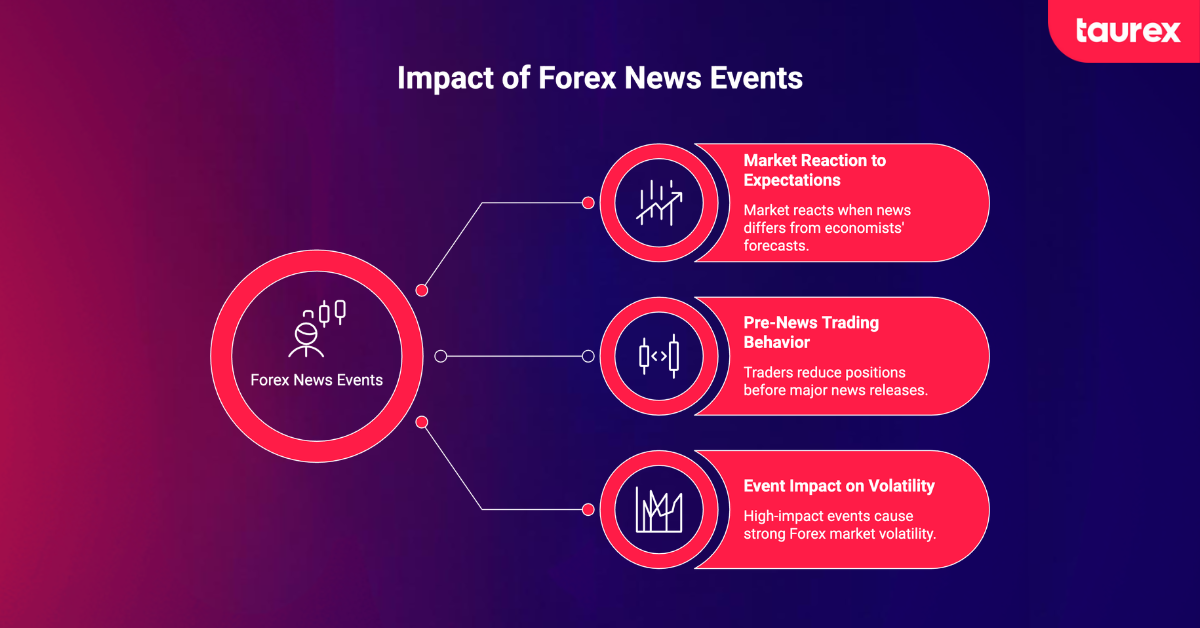
Before major news, large traders often reduce their positions. This is why price tends to move in tight ranges before a release. That quiet period does not mean nothing is happening. It means the market is waiting.
Economic calendars group events by importance. High-impact events like NFP, CPI, and central bank rate decisions usually create strong volatility. Lower-impact events rarely offer the same trading opportunities and often do not justify the risk.
What Are The Most Important Forex News Events to Trade?
Not every data release deserves your attention. These 4 categories dominate the Forex calendar, and understanding what each one measures and why it matters is the foundation of any credible news trading strategy in Forex.
Non-Farm Payroll (NFP)
The Non-Farm Payrolls report tracks the change in the number of employed people in the United States, excluding farm workers, government employees, private household employees, and non-profit workers. It is released on the first Friday of every month at 8:30 AM ET, and it is one of the most closely watched data points in global finance.
The logic is straightforward. A stronger-than-expected NFP reading tends to push the US dollar higher because it signals economic strength and raises the likelihood that the Federal Reserve will keep interest rates elevated. A weaker reading tends to put pressure on the dollar.
The reality of how to trade NFP is more nuanced than that, though. In March 2023, NFP printed at 311,000 jobs versus an expected 205,000, a massive beat that sent USD-based pairs surging.
Even a strong NFP beat can reverse within 15 minutes as institutional players take profits on the initial spike. The whipsaw risk around NFP is real, and it is one reason why timing your entry matters just as much as reading the headline number.
Consumer Price Index (CPI)
CPI measures changes in the prices consumers pay for a basket of everyday goods and services, covering everything from housing and food to healthcare and transport. The Bureau of Labour Statistics releases it monthly, and it serves as the primary inflation gauge in the US.
For CPI Forex trading, the figure that matters most is core CPI, which strips out food and energy prices because those categories are too volatile to reflect underlying inflationary trends. The Federal Reserve targets inflation around 2% to 3%. When core CPI comes in well above that range, markets tend to price in a more hawkish Fed, which strengthens the dollar. When it comes in below expectations, traders begin anticipating rate cuts, which weakens the dollar.
A practical example: when the November 2024 US CPI exceeded forecasts, the dollar strengthened as traders recalibrated their expectations for the Fed’s next move. CPI also feeds directly into bond yields, which in turn influence carry trade dynamics across multiple currency pairs.
Central Bank Decisions (Fed, ECB, BoE)
Central bank interest rate decisions are the single most powerful category of scheduled Forex events. The Fed, the European Central Bank, and the Bank of England each hold roughly eight meetings per year, and the outcomes ripple through every major pair on the board.
The mechanics are simple: a rate hike typically strengthens a currency because it offers higher yields to global investors, while a rate cut weakens it. Experienced news traders know, however, that it is often not the rate decision itself that drives the biggest moves. The press conference language, whether it leans hawkish or dovish, and the Fed’s dot plot projections can carry equal or even greater weight.
A perfect example is the BoE’s December 2025 meeting. A rate cut was almost certain going in, with markets pricing it above 90%. The cut came, but the pound went up. Why? The vote was a razor-thin 5 to 4 split, and Governor Bailey’s tone was cautious: “With every cut we make, how much further we go becomes a closer call.” Traders read that as the end of the cutting cycle being near, and sterling strengthened despite the cut.
Traders who simply shorted the pound expecting the cut to weaken it got it wrong. Those who waited for the press conference and read the tone correctly caught the real move.
Other Key Events (GDP, PMI, Unemployment)
Beyond the big three, several other releases deserve a spot on your watchlist. GDP, released quarterly, measures total economic output. PMI surveys act as leading indicators for economic direction. The unemployment rate, directly tied to central bank mandates, can shift rate expectations if it moves sharply in either direction.
These are secondary to NFP, CPI, and rate decisions, but they still carry enough weight to move markets, particularly when they surprise in the context of an already uncertain economic environment.
| Event | Frequency | Typical Time (ET) | Primary Impact |
| NFP | Monthly (1st Friday) | 8:30 AM | USD pairs |
| CPI | Monthly | 8:30 AM | USD pairs |
| FOMC Rate Decision | 8x per year | 2:00 PM | USD pairs, all majors |
| ECB Rate Decision | 8x per year | 8:15 AM | EUR pairs |
| BoE Rate Decision | 8x per year | 7:00 AM | GBP pairs |
| GDP | Quarterly | 8:30 AM | All pairs |
How to Trade Forex News Events
There are three distinct windows around any scheduled release, and each one calls for a different approach. The timing window you choose should match your risk tolerance and experience level.
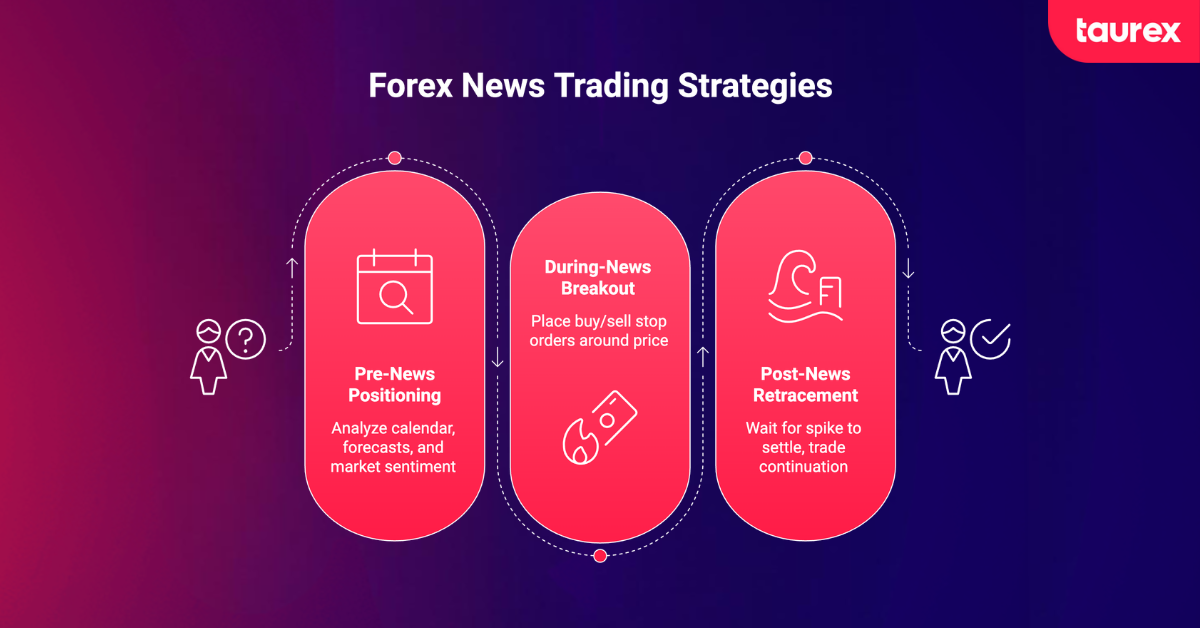
Trading Before The News (Positioning Strategy)
This means reviewing the economic calendar 24 to 48 hours ahead, identifying consensus forecasts and previous readings, and analysing what the market has likely already priced in. Before a major release, you will typically notice liquidity dropping and ranges narrowing as traders clear their books.
If you hold a strong conviction about the outcome, you could position ahead of the release with a tight stop. Be aware, though: if you are wrong, that stop will likely get hit in an environment where spreads are already widening.
For most traders, waiting for confirmation after the release is the more disciplined path.
Trading During The News Release (Breakout Strategy)
This is the classic Forex news trading approach. About two minutes before the release, place buy and sell stop orders roughly 20 to 30 pips above and below the current price. When the data prints, one order triggers. Cancel the unfilled order immediately.
The principle is to trade the surprise versus consensus, not the absolute number. A word of caution: spreads on EUR/USD can widen from a normal 1 pip to 10 pips or more during NFP. Some brokers also requote or delay execution.
Factor that into your position sizing so your worst-case fill stays within your predefined risk limits. At Taurex, spreads and execution conditions during major events are clearly disclosed so you can plan your trades with confidence.
Trading After The News (Retracement Strategy)
Rather than jumping in during the chaos of the first few seconds, this approach involves waiting for the initial spike to settle, typically 5 to 15 minutes, and then trading the continuation once a clear direction is established with volume confirmation.
There is a good reason for patience here. Currency pairs can spike 80 pips in one direction after NFP, only to completely reverse within 15 minutes.
If the move aligns with the broader trend you have identified through technical analysis, the post-news continuation trade can offer a better risk-to-reward profile than the initial breakout attempt.
5 Best Forex News Trading Strategies
Before trading any major release, traders need a clear plan for the event, entry timing, risk level, and exit rules. The following Forex news trading strategies can help traders respond to NFP, CPI, and rate decisions without relying on guesswork.
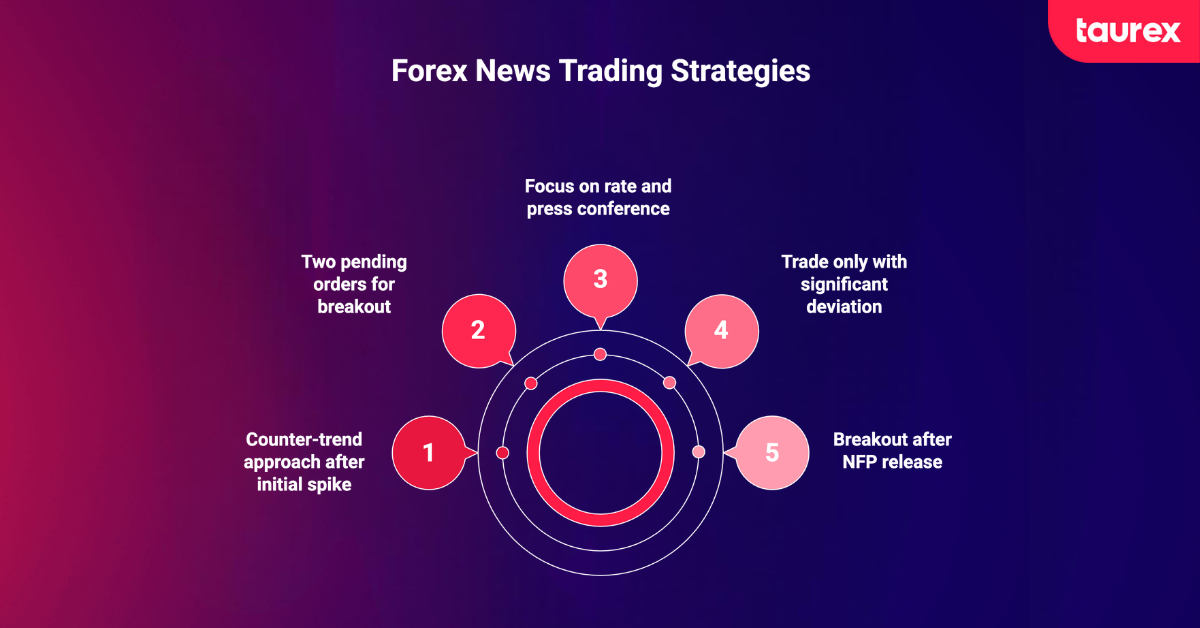
NFP Breakout Strategy
This strategy focuses on the breakout that often follows the NFP release.
Before the announcement, the price usually moves in a tight range. You place a buy stop above this range and a sell stop below it, ready to catch the breakout when the news hits.
However, not every release is worth trading. The move should be strong enough, meaning the actual NFP number is far from expectations. Smaller differences often lead to choppy price action that is hard to trade.
When one pending order triggers, cancel the other immediately. Adjust your stop for typical NFP slippage, which can be 12 or more pips on the first candle. The pairs that respond most consistently are EUR/USD, USD/JPY, and GBP/USD.
CPI Volatility Strategy
This strategy is based on a clear rule. If the CPI result does not differ enough from expectations, you do not trade.
The key threshold is a deviation of about 0.2 to 0.3 percentage points from the forecast. If the difference is smaller, the price often becomes unstable and difficult to read.
A higher-than-expected CPI usually strengthens the USD, as traders expect tighter monetary policy. A lower reading tends to weaken it as expectations shift. Even with a strong release, it is better to wait for direction to become clear before entering. The first moments after the news can be very unstable, with wide spreads and sharp moves, especially on volatile pairs that react strongly to US economic data.
Central Bank Rate Decision Strategy
Rate decisions are not just about the number. The press conference that follows is just as important. You should prepare two scenarios in advance. One for a more aggressive stance and one for a more cautious one. Each scenario should include a clear plan for entry.
It is common to see the first move after the rate decision reverse once the press conference begins and traders process the full message. If the outcome leads to a real shift in sentiment, the move can continue for days, not just minutes.
Straddle Strategy for News Trading
The straddle strategy places two pending orders around the current price before the news release. One order sits above the price and the other below it, usually within a short distance based on the pair and event. This is done a few minutes before the announcement.
When one order is triggered, the other must be cancelled immediately. Keeping both active can lead to losses if the price quickly reverses. This method works best on highly liquid pairs like EUR/USD, especially during major events such as NFP and rate decisions, where strong moves are more likely.
Fade The Initial Move Strategy
This is a counter-trend approach used when the first move after the news looks too strong or does not match the data.
After the initial spike, wait for the market to settle. Then watch for signs of a reversal on lower timeframes like the 1-minute or 5-minute chart. Common signals include doji candles, engulfing patterns, or divergence on momentum indicators.
The idea is to trade the move back toward the pre-news price level. These setups happen because the first spike is often driven by fast orders and low liquidity, which can push the price too far in a short time.
Once that initial burst slows down, the price often corrects as the market returns to a more balanced level.
Best Tools for Trading News Events in Forex
Successful Forex news trading depends on more than the strategy itself. Traders also need the right tools to track upcoming releases, receive data quickly, and manage execution risk during high-volatility market conditions.
Economic Calendar (How to Use It)
Start by checking the economic calendar before each trading day. Focus on high-impact events linked to the pairs you trade. The key is to compare three values: forecast, previous, and actual. The difference between forecast and actual is what usually drives price movement.
Filtering by your trading session time zone helps you stay focused on what is relevant.
News Feeds And Real-Time Data
Speed matters in Forex news trading. Prices can move within seconds, so having access to real-time data is important.
Professional traders rely on fast news feeds that publish results the moment they are released. This allows you to react quickly, especially when your entry depends on timing.
Forex Brokers
How you choose your broker plays a big role during news events. Spreads can widen significantly, especially during releases like NFP.
If spreads increase too much, it becomes harder to trade profitably because the price has to move further just to cover the cost of entry.
Look for brokers with transparent pricing, and always check that your broker is properly regulated with segregated client funds and fund protection.
Taurex offers competitive trading conditions designed for active Forex traders, including tight spreads on major currency pairs, fast order execution, and access to deep liquidity for more stable pricing during volatile market events.
This combination of pricing efficiency, execution speed, and regulatory oversight makes it a practical choice for traders who need more control during fast-moving news conditions.
What Are The Most Common Mistakes in Forex News Trading?
Forex news trading mistakes usually happen when traders react too quickly, use normal market rules during abnormal volatility, or enter without a clear plan. The most common issues come from poor timing, oversized positions, weak execution planning, and emotional decisions after sharp price moves.
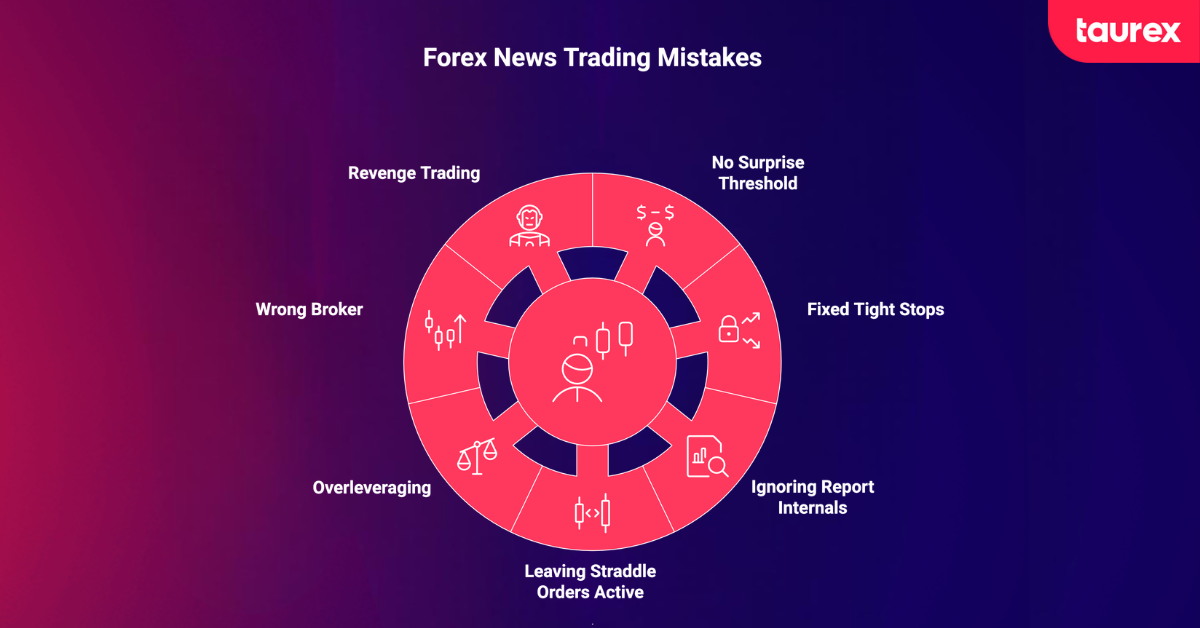
- Trading without a defined surprise threshold. Write your entry criteria before the release. For example: “NFP surprise of plus or minus 150,000 jobs, or unemployment change of plus or minus 0.2 percentage points.” No threshold means no trade.
- Using fixed tight stops during news. Stops need to be placed beyond structure and expected slippage, not at a fixed pip count. The noise during the first minute of a major release can easily sweep a 10-pip stop before reversing in the direction you originally anticipated.
- Ignoring the report’s internals. The headline number is not always the real driver. Sub-components such as core services, CPI or average hourly earnings often trigger what traders call the “second move,” which can be larger than the initial reaction.
- Leaving both straddle orders active. The moment one order triggers, cancel the other. This is the single most common and most devastating beginner error in news trading.
- Overleveraging during the news. Reduce your position size to 25 to 50% of your normal sizing. Volatility during news events can generate 3 to 10 times the normal average true range on the first candle alone.
- Trading with the wrong broker. If spreads balloon during releases, even a perfectly timed entry loses its edge. Research your broker’s behaviour during major events before committing real capital. Understanding the different types of Forex brokers helps here.
- Revenge trading after a whipsaw. The second trade placed immediately after a whipsaw loss is almost always driven by emotion. If your setup is invalidated, stand aside until the price establishes a new structure. Discipline is what separates prepared traders from those who end up on the losing side. According to ESMA data, 74 to 89% of retail Forex accounts lose money, and trading news events without preparation tends to accelerate those losses.
Wrapping Up
A news trading Forex strategy built around NFP, CPI, and central bank decisions can be very structured. These events are scheduled, the timing is known, and the price often reacts in clear ways.
The advantage does not come from guessing the result. It comes from reacting to the surprise, using clear rules, managing risk, and having the right tools in place.
Prepare before the release, manage the trade during the event, and stay patient after.
If you are still learning this approach, it is best to start on a demo account. At Taurex, you can open a demo account, where you can practice trading news events, watch how the price reacts, and build confidence without risking real money.
FAQ
What is the best news event to trade in Forex?
The most popular events are NFP and central bank rate decisions. These usually create the biggest moves on major USD pairs and happen on a regular schedule. CPI is also important, especially when inflation is a key focus, since it can quickly change market expectations.
How do you trade NFP safely?
Use clear rules before entering a trade. Only trade when the result is far from expectations. Reduce your position size compared to normal trading. Place stop losses based on market structure, not fixed distances. It is also best to avoid the first moments after the release when spreads are widest. If you use a straddle strategy, always cancel the second order as soon as one is triggered.
Is trading Forex news risky?
Yes, it is riskier than normal trading. Spreads can widen, orders may slip, and prices can move very quickly in both directions. These risks can be managed by using smaller positions, clear rules, and trading with brokers that offer stable conditions.
What time are major Forex news releases?
Most US data, including NFP and CPI, is released at 8:30 AM ET. Central bank decisions usually come later, followed by a press conference. European releases and decisions often happen earlier in the day. Checking an economic calendar daily helps you stay prepared.
Should beginner Forex traders trade news events?
Not at the start. It is better to first watch how the market reacts using a demo account. News trading in Forex involves fast moves and emotional pressure, which can be difficult for beginners. Building basic trading skills should come first.
Which Forex pairs move the most during news?
EUR/USD is the most active during US news. GBP/USD and USD/JPY also show strong moves during major releases. USD/CAD can react sharply to both US and Canadian data. AUD/USD often moves during Australian and Chinese economic updates.
Why do many Forex traders fail at news trading?
Common Forex trading mistakes include trading without clear rules, using too much leverage, ignoring spread changes, and not managing orders properly. Emotional decisions after losses also play a big role. Traders can lose money, and poor preparation during news events often makes results worse.